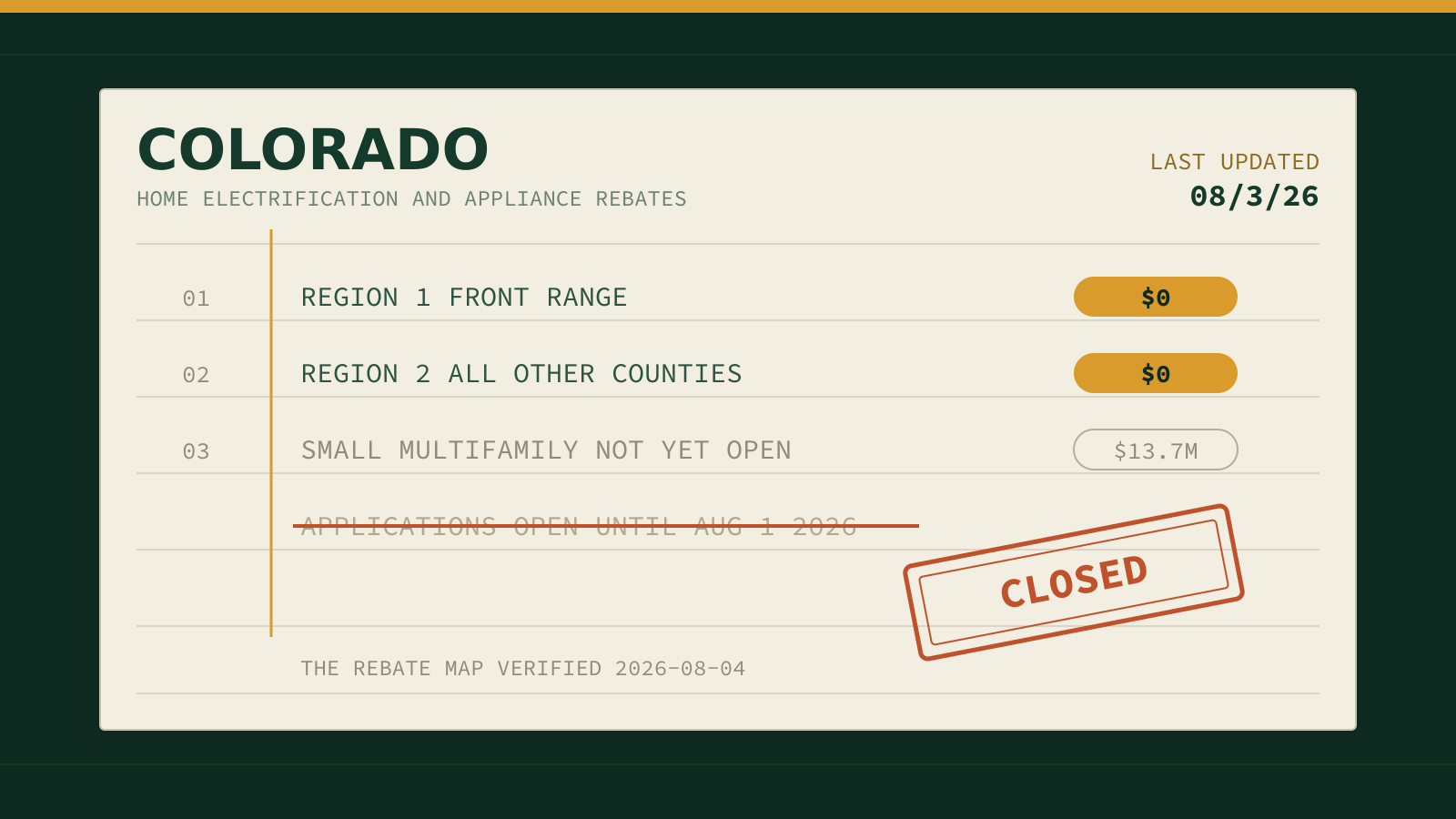
Colorado’s HEAR single-family rebate funding reached $0 remaining in both of the state’s rebate regions as of the dashboard’s own “Last Updated: 08/3/26” stamp. The Colorado Energy Office’s funding availability page marks Region 1 (Front Range) and Region 2 (all other counties) alike as “Program Closed.” That is the entire single-family Home Electrification and Appliance Rebates program, statewide, showing nothing left.
The program’s main page has not caught up. On August 4, 2026, under a banner headed “Important Program Update” and stamped “(Updated June 2026),” it still reads: “The HEAR Single-Family Program for Region 2 is accepting applications until August 1, 2026, unless funding is reserved sooner.” That sentence describes a window that closed three days before this article was written, and it sits directly above a link to the dashboard that contradicts it. Update, August 15, 2026: the program page has since caught up. It now carries an (Updated August 2026) stamp and states that the HEAR single-family program is closed for both Region 1 (the Front Range) and Region 2 (All Other Counties). The contradiction described above lasted about ten days.
If you are a Colorado homeowner who found the program page first — which is what happens when you search for a Colorado heat pump rebate — you would reasonably conclude you had missed a deadline by a few days. The dashboard tells a harsher and more useful story: the money, not the calendar, is what ended the program, and it ended in both regions.
What the dashboard says, line by line
The Colorado Energy Office publishes HEAR funding availability at a dedicated dashboard page. Note that the URL you may have bookmarked earlier this year, `/home-energy-rebates-dashboard`, now returns a 404; the live page is at `energyoffice.colorado.gov/hear-dashboard`.
The figures below are the dashboard’s own, read on August 4, 2026, and carry its own “Last Updated: 08/3/26” stamp. The office states that “The HEAR program funding availability dashboard will be updated on Monday’s by the end of day” and that “Funding amounts are approximate and subject to change.”
| Bucket | Remaining | Status shown |
|---|---|---|
| Region 1: Front Range | $0 remaining | Program Closed for Region 1 |
| Region 2: All Other Counties | $0 remaining | Program Closed for Region 2 |
| Small Multifamily: Statewide | $13.7M remaining | Rebates are not yet available for multifamily buildings |
The totals behind those buckets are also published: “A total of approximately $45.6 million is available for HEAR rebates, with about $31.9 million available for rebates to single-family households and $13.7 dedicated for multifamily buildings smaller than 50,000 square feet.” (The missing unit after “$13.7” is the state’s own typo; the dashboard’s remaining-balance line renders it as $13.7M.)
So the arithmetic is straightforward. Roughly $31.9 million was set aside for single-family households across the whole state. That pool is now reported as fully reserved. The $13.7 million for small multifamily buildings is untouched, and untouchable — Colorado says those rebates “will not be available until later this year.”
How fast this happened
Region 1 went first, and Colorado said so plainly: “The HEAR Single-Family Program for Region 1 (Front Range) is closed. Any household applications and project proposals submitted after April 27, 2026 for Region 1 will not be reviewed and will be denied.”
That is unusually blunt language for a state rebate page. It does not say applications will be waitlisted or held pending additional appropriations. It says they will be denied.
Region 1 covers fourteen counties: Adams, Arapahoe, Boulder, Broomfield, Clear Creek, Denver, Douglas, Elbert, El Paso, Gilpin, Jefferson, Larimer, Teller, and Weld. That is where most of Colorado’s population lives, which is presumably why it exhausted first. Region 2 is the remaining fifty counties.
Region 2 lasted about three more months. When we checked this same dashboard on July 29, 2026, it carried a “Last Updated: 5/15/26” stamp and showed Region 2 with roughly $4.6 million remaining. The next refresh we have seen — the August 3 one — shows $0. Between a stale mid-May snapshot and the first August update, the last several million dollars were claimed.
That gap between refresh dates matters more than it looks. Colorado updates the dashboard weekly, on Mondays. A homeowner who checked in June or July saw a May number and would have had no way to know how much of that $4.6 million was already spoken for by pending project proposals.
The sentence that decides whether you still get paid
Buried in the same banner that advertised the now-expired August 1 date is the operative rule: “As a reminder, you are not guaranteed a rebate until you and your registered contractor receive a formal reservation notice for your project.”
Everything turns on that document. Colorado’s HEAR program is reservation-based, not first-come-first-paid-at-install. Submitting a household profile does not reserve money. Getting a contractor to draw up a Project Proposal does not reserve money. Only the formal reservation notice does.
If you and your registered contractor hold a reservation notice issued before the funds ran out, your project is inside the system and the rebate is attached to it. If you submitted paperwork and never received one, the dashboard’s $0 is your answer, and the Region 1 language suggests what Region 2 applicants can expect: not a waitlist, but a denial.
There is one further trap in the process rules. Colorado states that “Incomplete household profiles, including those not connected to a Project Proposal, will not be reviewed and will expire after 90 days.” A profile you started in spring and never attached to a contractor’s proposal has likely expired on its own, independent of the funding situation.
The state also warned, before the money ran out, that “Due to a high demand in program participation, applications are taking longer to review.” Applications submitted in the final weeks may still be in the review queue. Whether a reservation notice issued after the pool hit zero is honored is a question the published pages do not answer, and we are not going to guess at it. The Help Center number is 866-336-0016 and the program email is [email protected]; a project sitting in review is worth a phone call rather than a wait.
What the amounts were, for anyone holding a reservation
If you have a reservation notice, these are the caps your project is measured against. They are per-category lifetime maximums, and the whole household is capped at $14,000.
| Upgrade | Maximum rebate |
|---|---|
| Cold climate heat pump for space heating and cooling | $8,000 |
| Heat pump for space heating and cooling | $3,000 |
| Heat pump water heater | $1,750 |
| Electric load service center (electric panel) | $4,000 |
| Electric wiring | $2,500 |
| Insulation, air sealing, and ventilation | $1,600 |
| Electric stove, cooktop, range, or oven | $840 |
| Total maximum rebate | $14,000 |
Colorado adds one condition to the whole table: “Note, all upgrades must be ENERGY STAR® certified.”
The cold-climate distinction is worth understanding because it is the difference between $8,000 and $3,000 on the single largest line. Colorado pays the higher amount only for equipment certified for cold-climate performance — a meaningful requirement in a state where a standard-rated heat pump can lose capacity exactly when a Front Range winter needs it most.
How much of your project cost those caps actually cover depends on income:
| Household income | Share of qualified project cost covered |
|---|---|
| Below 80% of Area Median Income | 100% |
| 80% to 150% of Area Median Income | 50% |
Both tiers are still bounded by the dollar caps above. A household below 80% AMI installing a $9,500 cold-climate heat pump does not get $9,500; it gets $8,000, because the category cap binds first.
What is still open in Colorado
Two things.
Small multifamily HEAR. The $13.7 million for buildings under 50,000 square feet has not been spent because it has not opened. Colorado says these rebates “will not be available until later this year.” If you own or manage a small multifamily building in Colorado, this is the one pool with money in it, and there is time to get a contractor lined up before it opens.
Home Efficiency Rebates (HER). Colorado’s HER track is separate from HEAR and pays on measured or modeled whole-home energy savings rather than on specific appliances. The state has published the HER structure for manufactured and mobile homes and for large multifamily buildings, with availability described as 2026.
For manufactured and mobile homes:
| Household income | Modeled energy savings | Share of cost | Maximum |
|---|---|---|---|
| Below 80% AMI | 20% to 34% | 100% | $14,000 |
| Below 80% AMI | 35% or more | 100% | $16,000 |
| 80% AMI or above | 20% to 34% | 50% | $2,000 |
| 80% AMI or above | 35% or more | 50% | $4,000 |
For large multifamily buildings of 50,000 square feet or more:
| Tenant income | Modeled energy savings | Rebate |
|---|---|---|
| Below 80% AMI | 20% to 34% | $4,000 per unit or 80% of cost, whichever is less |
| Below 80% AMI | 35% or more | $8,000 per unit or 80% of cost, whichever is less |
| 80% AMI or above | 20% to 34% | $2,000 per unit, up to $200,000 per building |
| 80% AMI or above | 35% or more | $4,000 per unit, up to $400,000 per building |
The $16,000 line for manufactured homes below 80% AMI is the single most generous residential number Colorado publishes, and it is higher than anything available under HEAR. Manufactured housing is also where deep percentage savings are easiest to reach, because the starting envelope is usually the worst in the state’s housing stock. If you are in that category and were waiting on HEAR, HER is the better target anyway.
Who was eligible, and who was not
Colorado’s rules are stricter than several other states’ on one point that catches people out: “you must reside in an existing home (new construction is ineligible) in Colorado for at least half of the year. Secondary homes and vacation homes are not eligible. Rental homes and units occupied by income-qualified tenants can participate.”
Three separate exclusions there. New construction is out entirely — a builder cannot put HEAR money into a new house. The half-year residency requirement rules out a Colorado property you visit. And the explicit mention of vacation homes closes the obvious workaround in a state with a great deal of second-home ownership in the mountain counties.
The rental clause runs the other way and is easy to miss. A landlord can participate, provided the unit is occupied by an income-qualified tenant. The tenant’s income, not the owner’s, is what the program looks at.
By contrast, North Carolina’s HEAR program explicitly welcomes new construction for its appliance categories — a genuine difference in how two states read the same federal program, and one reason a national summary of “the $8,000 heat pump rebate” is close to useless for planning an actual project.
The six steps, and where most projects died
Colorado published a six-step participant journey: check eligibility, contact a registered contractor, apply, get an assessment and a Project Proposal, install, and receive the benefit.
The structural point is that steps two and four are gated by contractors. HEAR money in Colorado moves only through registered contractors, and a Project Proposal is a contractor document. A homeowner cannot self-serve through this program. When funding is running out, that means your position in the queue is set by how quickly a registered contractor in your county can get to you — not by when you decided you wanted a heat pump.
That is the mechanism behind the 90-day expiry rule. Households created profiles, could not get a contractor appointment inside three months, and the profiles expired without ever reaching a Project Proposal, let alone a reservation notice.
What Colorado does not say
We searched the full text of the Colorado Energy Office’s rebate pages on August 4, 2026 for any mention of fuel switching, of DOE Program Notice 26-2, or of the term “26-2” in any form. There are none.
This matters because on May 29, 2026, the Department of Energy removed fuel switching from what HEAR is allowed to pay for. Under the notice, HEAR rebates apply to replacing existing electric equipment with higher-efficiency electric equipment; the dollar caps were left alone, but a gas-furnace-to-heat-pump conversion is no longer a qualifying HEAR project. State programs that were already launched were given three months — to August 29, 2026 — to come into compliance, with existing approved reservations allowed to execute.
Colorado’s silence on this is not unique. Across the twenty-four state programs we have audited, not one publishes the August 29 federal compliance date. But Colorado’s silence is now largely academic for single-family households: with both regions at $0 and closed, there are no new reservations to make non-compliant. The question that remains open is what the notice means for small multifamily HEAR, which Colorado intends to launch “later this year” — that is, after the compliance deadline. Whatever Colorado opens in the fall will have to be an existing-electric-to-electric program from day one.
We have written separately about what changed on May 29 and what it means for a gas-furnace household.
What to actually do now
If you hold a reservation notice: proceed. Your project is funded. Confirm with your registered contractor that all equipment on the proposal is ENERGY STAR certified, because that condition applies to every line in the table and is checked at the benefit stage rather than at reservation.
If you applied and never received a reservation notice: call 866-336-0016 or write to [email protected] and ask directly whether your project has a reservation. Do not infer it from an acknowledgment email. Region 1’s published rule is that post-April-27 submissions “will not be reviewed and will be denied,” and there is no published reason to expect Region 2 to be treated differently now that it reads $0.
If you have not applied: the single-family door is shut. Redirect to the federal tax credit route, which is a different mechanism with a different eligibility test and does not depend on Colorado’s dashboard at all. We compare the two in tax credit versus rebate.
If you own a small multifamily building under 50,000 square feet: this is your window. $13.7 million is sitting unspent and the program has not opened. Get a registered contractor relationship in place now.
If you live in a manufactured or mobile home: look at HER rather than HEAR. The $14,000 and $16,000 tiers for households below 80% AMI are larger than what HEAR offered, and that pool has not been drawn down.
Everyone: check the dashboard yourself rather than the program page. Colorado refreshes the dashboard weekly on Mondays; the program page carries a June stamp and, as of August 4, an expired date. When two official pages disagree, the one with the newer timestamp and the specific dollar figures is the one to trust.
Colorado is not the only state where the published deadline and the actual money ran on different clocks. California’s single-family HEEHRA pool was fully reserved in February 2026 and has been running a waitlist ever since, with no published positions and no reopening date. Our state-by-state tracker records what each program’s own pages say, with the date we read them, precisely because pages like this one go stale while the search results keep sending people to them.
Sources
All figures and quotations above were read directly from the following pages on August 4, 2026:
- Colorado Energy Office, Home Energy Rebates: `https://energyoffice.colorado.gov/home-energy-rebates`
- Colorado Energy Office, HEAR Dashboard: `https://energyoffice.colorado.gov/hear-dashboard`
Where a figure is not published by the state, we say so rather than estimating it. The remaining balances above are the state’s own approximations and are described by the state as “subject to change.”