Category: Home Energy Rebates

  • The Heat Pump Rebate Rule Changed in May. We Checked 24 State Programs and Only Six Mention It

    On May 29, 2026 the Department of Energy stopped letting the federal home electrification rebate pay for the one upgrade most people wanted it for: pulling out a gas furnace and putting in a heat pump. The money is still there. The 8,000 dollar ceiling is still there. The project most people had in mind no longer qualifies.

    States that had already launched were given three months to conform. That window closes on August 29, 2026.

    So we did the obvious thing. On July 29, 2026 we opened the official program page for twenty-four states and territories, one at a time, and looked for the answer to a single question: does this page tell a homeowner that the rule changed?

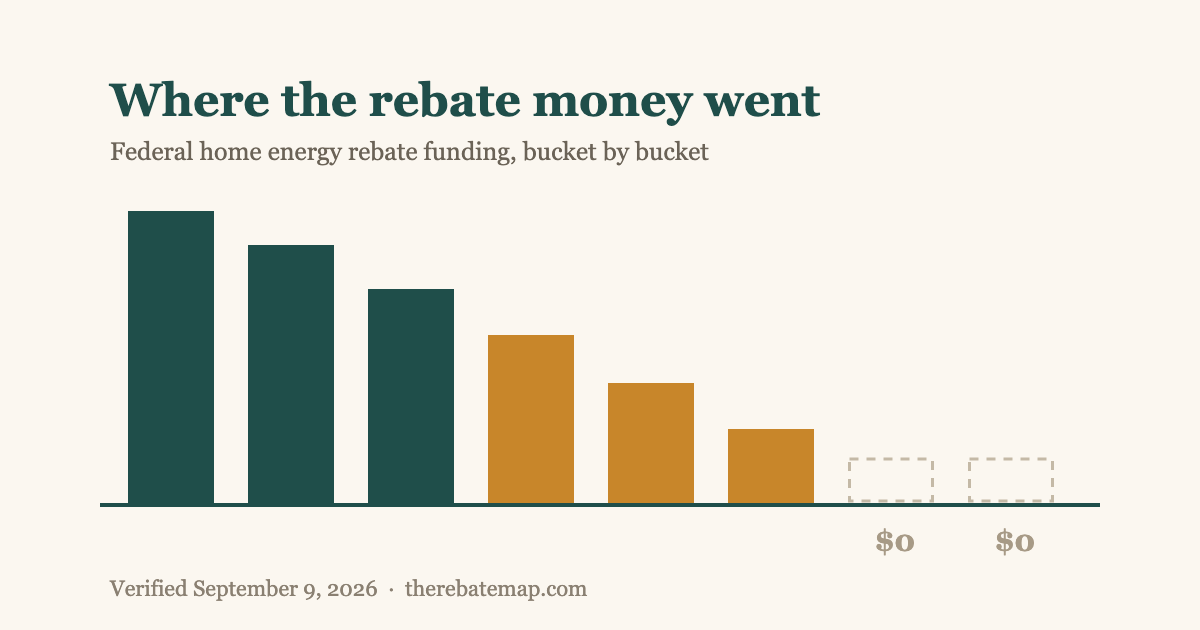
    Three do. One publishes a deadline without saying what the deadline is for. Two confirm the notices exist and stop there. Eighteen say nothing at all. And six of those eighteen are accepting applications right now while the page still tells you to replace a non-electric appliance.

    Last verified against official sources: July 29, 2026. Nothing here is tax advice or legal advice, and rebate programs change without notice, which is the entire point of this page.

    What changed, in one paragraph

    DOE Program Notice 26-2 removed fuel switching from the Home Electrification and Appliance Rebates program. In DOE’s words, it is “Removing program allowances for upgrades for fuel-switching (i.e. replacement of non-electric appliances) and instead allowing rebates for upgrading HVAC and appliances only from existing electric equipment to more efficient electric equipment.” Existing approved reservations survive: “Any existing, approved rebate reservations under the previous program guidance are allowed to be executed, but no new rebate reservations are allowed or can be approved for projects that do not conform to the new program strategy.” Launched programs “are required to make changes within three months of the publication of this Program Notice.” We walked through the full text, including the parts that contradict each other, in our piece on why the 8,000 dollar heat pump rebate stopped covering gas furnace replacements.

    The three states that actually told you

    Georgia is the clearest in the country. Its HEAR Program Update page, dated May 29, 2026, gives contractors a hard hour: scopes of work must be submitted by “10:00 am ET on August 10, 2026.” After that, in Georgia’s own words, “fuel switching projects will no longer be accepted, and only electric-to–higher-efficiency electric upgrades will be eligible.” Full implementation is set for August 31, 2026.

    Wisconsin is the only state we found that is open, taking applications, and has published the restriction. Focus on Energy, the statewide administrator working under the Public Service Commission, says plainly: “Starting September 1, 2026 we can no longer accept retail applications or coupons replacing fossil-fuel appliances.” It gives a cutoff to the minute. “The last day to submit post-purchase retail applications for appliances replacing fossil fuel equipment is August 31, 2026, at 5:30 p.m. CT.” Retail coupons through Lowe’s carry the same wall: “Lowe’s coupon reservations must be made by August 31, at 5:30 p.m. CT.” The Commission itself confirms the program is still running while it reads the guidance: “Wisconsin’s programs remain operational while the guidance is under review.”

    Virginia has not launched, and says the change anyway. Its FAQ opens with “The information below reflects the updated Program Notices released by US Department of Energy on May 29, 2026,” then states the consequence in one line: “According to federal law, High Efficiency and Appliance Rebates cannot be used to help pay for replacement of a non-electric appliance.” Virginia is also candid that it cannot tell you when any of this will matter: “Virginia Energy cannot provide an estimated date on when Home Energy Rebates will be available.”

    Arizona published a date and left out the reason

    Arizona’s rebate site tells residents they are “encouraged to apply by August 1, 2026 to access current rebate guidelines.” That is next Saturday. The page does not explain what the current guidelines are, what the new ones will be, or that a federal notice is the reason the sentence exists. A homeowner reading it has three days of useful warning and no idea what they are racing.

    Two states confirmed the notices exist and said nothing about them

    Washington’s federal rebate page states that “The Department of Energy released updates to the program guidelines (program notices 26-1 and 26-2) on June 1,” followed by “We’re evaluating how these changes affect the program and are working with our rebate administrator to determine next steps.” The words fuel switching do not appear.

    Maryland is nearly identical. Its June 9, 2026 update says “The U.S. Department of Energy (DOE) issued Program Notices on June 1, 2026” and “MEA is currently reviewing the updated guidance and evaluating its implications for Maryland’s programs.” Further down, the same page still describes its program as being “for replacing fossil-fuel appliances (e.g., fuel oil, natural gas, etc.) with electric alternatives” — the exact thing the notice removed.

    Both states date the notices to June 1. DOE’s own notice, and Virginia, say May 29. Two months later that three-day discrepancy is still sitting on two state government websites, uncorrected.

    The eighteen that have said nothing

    We found no reference to Program Notice 26-1, Program Notice 26-2, fuel switching, or an electric-to-electric restriction anywhere on the official program pages of California, New York, Colorado, New Hampshire, Oregon, South Carolina, North Carolina, Maine, New Mexico, Michigan, Rhode Island, Minnesota, Massachusetts, Illinois, the District of Columbia, Connecticut, Vermont, or Nevada.

    For most of these the silence is defensible. Minnesota has not launched: “Save Energy Minnesota has not launched yet.” Connecticut has not launched: “Rebates will not be available until the programs are launched.” Massachusetts is waiting on Washington: “DOER is waiting for the U.S. Department of Energy’s final approval to launch.” Illinois has not launched: “The program launch is pending USDOE approval.” Nevada has not launched: “Project Launch: Pending federal review and program guidance.” New Hampshire has not launched and its page has not been touched in over two years — the stamp reads “Webpage Last Updated: 04/17/2024.” A program with no applicants has nobody to mislead.

    Oregon deserves its own line, because its explanation is the most useful sentence any state has published this year: “U.S. DOE has suspended their approvals of all launch requests from state home energy rebate programs.”

    The six that are open right now and still publish the old rule

    This is the group that matters, and it is where the risk actually lives.

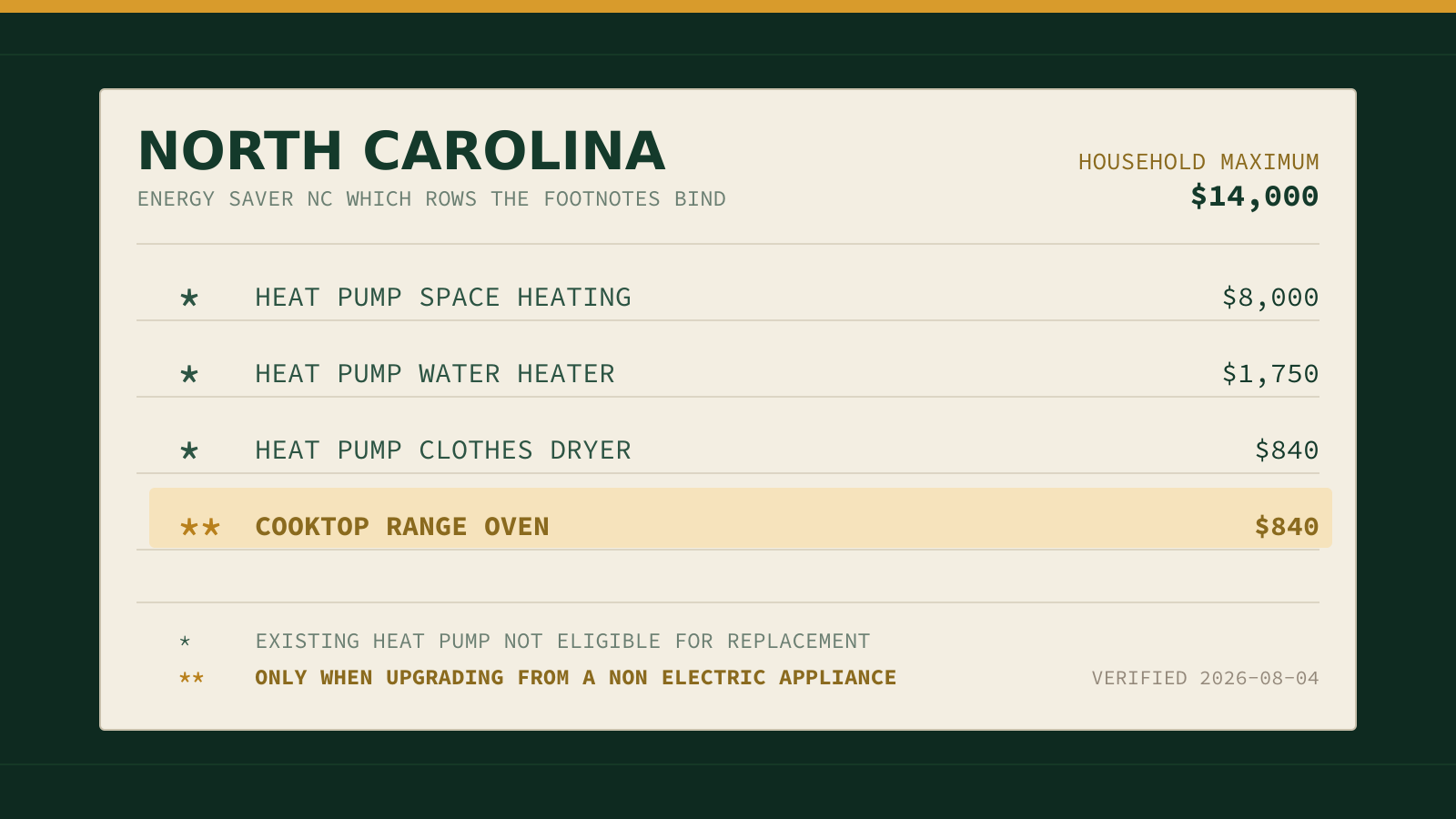
    North Carolina launched both programs in January 2025 and is running statewide: “Energy Saver North Carolina is active in every county across the state,” operating “on a first come first serve basis.” Its HEAR page still says “Rebates are available only when upgrading from a non-electric appliance.” That is the pre-May-29 rule, published today, on a program taking applications today.

    New Mexico has been live since September 3, 2024 and its FAQ still reads “The program has begun. Please visit CleanEnergy.nm.gov to get started.” Its HEAR page was last modified May 18, 2026 — eleven days before the notice — and still conditions appliance rebates on replacing a non-electric model.

    Michigan is open and says so twice: “We are currently accepting applications from low-to-moderate-income residents across the state” and “The program is live and accepting applications.” Four separate state pages, including the FAQ and the contractor page, carry no mention of the change and no last-updated date at all.

    Maine reports “The HEAR program is now live and promoting qualifying electrification measures,” with no mention of the change on any state page we could read.

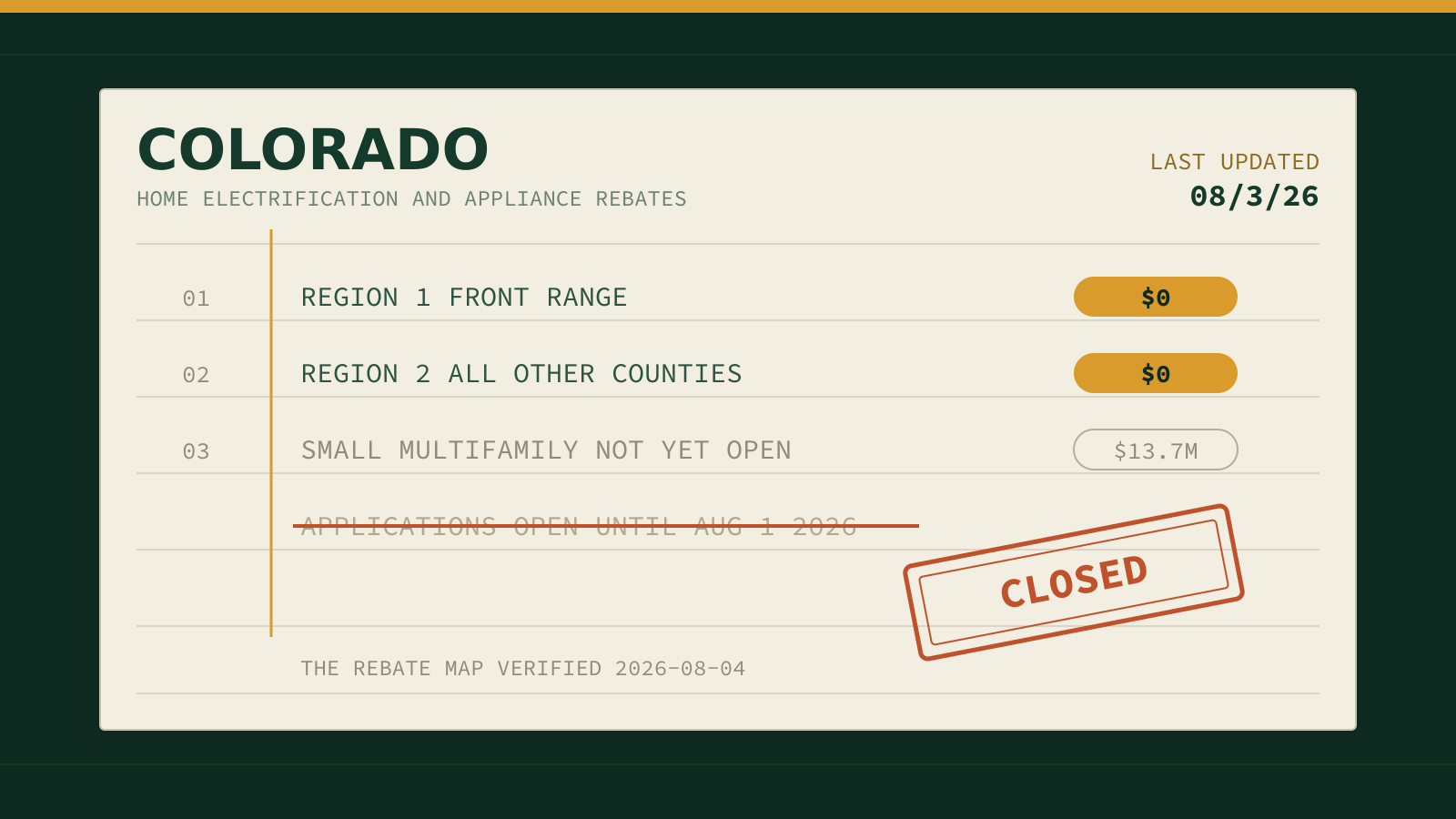
    Colorado is open in one of two regions and closed in the other: “The HEAR Single-Family Program for Region 1 (Front Range) is now closed,” while “The HEAR Single-Family Program for Region 2 continues to be available and is accepting applications until remaining available funding is fully reserved.” Region 2 has a published cutoff of August 1, 2026 and 4.6 million dollars left on its own dashboard. Nothing on the main page, the FAQ, the dashboard, or the contractor page mentions fuel switching. Colorado also warns, correctly, that applying is not qualifying: “you are not guaranteed a rebate until you and your registered contractor receive a formal reservation notice.”

    Rhode Island launched its income-eligible pathway on September 17, 2024. The application form it posted in April 2026 still asks whether the cooking appliance being replaced is gas or propane, and still lists gas capping as an eligible upgrade type.

    Six programs. All open. All still describing an upgrade that DOE stopped funding two months ago.

    South Carolina publishes the exact opposite rule

    South Carolina has not launched, so nobody is harmed yet, but its page is the cleanest illustration of how far behind the documents are. It currently states: “Replacement of an existing heat pump, even with a more efficient electric heat pump, is not eligible for a rebate, per the DOE guidance.”

    Under Program Notice 26-2, replacing an existing heat pump with a more efficient electric heat pump is close to the only thing that is eligible. The state is publishing the inverse of the current federal rule and attributing it to DOE.

    The dates that do not line up

    Wisconsin’s cutoff is August 31, 2026, and its new requirements take effect September 1, 2026. DOE’s three-month conformance window closes August 29, 2026. Wisconsin’s own pages do not explain the two-day gap, and DOE has not published a state-by-state conformance status. We are not going to guess whether Wisconsin has an approved extension, because neither government has said.

    Not one of the twenty-four jurisdictions publishes the August 29, 2026 conformance date. Georgia comes closest with August 31 for full implementation. The federal deadline that is driving every one of these state deadlines appears on no state website we found.

    What we could not verify, stated plainly

    We could not read Efficiency Maine’s HEAR program page. Its HTML requires JavaScript and would not load for us; only its PDFs were readable. Maine’s silence is therefore a finding about the state site and the current rebate PDFs, not a confirmed negative for the administrator’s own program page.

    We could not read New Hampshire’s news index, which returned an HTTP 403. If New Hampshire posted something there, we did not see it.

    We could not read one Virginia page and one North Carolina program page directly; the Virginia findings above come from the FAQ, which is the only substantive page the state currently serves.

    We do not know how many states have applied for the extension DOE allows for “extenuating circumstances that require DOE approval.” DOE has not published a list, and no state has said it asked.

    We do not know which states have launched, full stop. DOE’s own program page as of July 8, 2026 says only that rebates are “now available in select states” and that “Additional details on active state, territory or Tribal rebate programs are coming soon.” The list in this article is ours, assembled state by state, because the federal government does not publish one.

    We did not check all fifty states. Twenty-four jurisdictions are covered here. The absence of a state below is not evidence about that state.

    What to do in the next ten minutes

    If you are in Georgia, look at the clock. Scopes of work are due at 10:00 am ET on August 10, 2026, and a contractor needs lead time to write one.

    If you are in Arizona, the page says apply by August 1. That is this Saturday.

    If you are in Wisconsin and you were replacing a gas appliance through the retail path, you have until 5:30 p.m. CT on August 31, 2026, and reservations at Lowe’s close at the same moment.

    If you are in Colorado Region 2, Maine, Michigan, New Mexico, North Carolina, or Rhode Island, assume the page is stale and call the program before you sign anything. Ask one question: is a reservation for a gas-to-electric project still being approved, and if I get one today, will it survive August 29? A reservation already approved is protected by the notice. A quote from a contractor is not a reservation.

    If your state has not launched, there is nothing to race. Watch for the launch, and expect the rules at launch to be the new ones, not the ones currently on the page.

    Whatever your state, screenshot the page you are relying on, with the date visible. Six state programs are currently publishing a rule that federal guidance replaced two months ago, and you may need to show what you were told.

    Where to go next on this site

    If you want the full text of what DOE changed and the internal contradictions in it, read our breakdown of the fuel switching removal. If you want to know what your state pays and who administers it, start with home energy rebates by state. If you are trying to work out whether the 8,000 dollar figure is real where you live, we checked what each state actually publishes about the 8,000 dollar heat pump rebate. If you are not sure you qualify at all, the income rules are a separate question from the equipment rules, and they did not change. And if you were counting on the tax credit instead, that is a different program on a different timeline.

  • The $8,000 Heat Pump Rebate Stopped Covering Gas Furnace Replacements on May 29, 2026

    On May 29, 2026, the Department of Energy changed what the federal home electrification rebate pays for. There was no press conference. The change arrived as two documents, Program Notice 26-1 and Program Notice 26-2, and the second one removed the most common reason American homeowners were applying in the first place.

    If you heat with gas, oil, or propane and you were planning to use the rebate to install a heat pump, that project is being phased out of the program. The language in Program Notice 26-2 is direct. The notice describes “Removing program allowances for upgrades for fuel-switching (i.e. replacement of non-electric appliances) and instead allowing rebates for upgrading HVAC and appliances only from existing electric equipment to more efficient electric equipment.”

    The dollar figures did not shrink. The statute still authorizes up to $8,000 for a heat pump and up to $14,000 in total. What changed is who the money is for. It is now for households that already heat with electricity.

    Because DOE gave states three months to comply, several states have already published hard cutoff dates. Georgia set August 10. Arizona set August 1. Both are inside the next two weeks.

    Last verified against official sources: July 29, 2026. Nothing here is tax or legal advice. It is a record of what the primary documents say on the date we read them.

    What the two notices actually changed

    Both notices carry an effective date of May 29, 2026. Program Notice 26-1 governs the HOMES rebate. Program Notice 26-2 governs the program the statute calls High-Efficiency Electric Home Rebates, which DOE and most states have been calling HEAR, HEEHR, or HEEHRA.

    Notice 26-2 supersedes specific parts of three earlier documents: the Administrative and Legal Requirements Document version 2.1 issued December 16, 2024, the Program Requirements and Application Instructions version 2.1 issued the same day, and the Data and Tools Requirements Guide version 2.0 issued January 7, 2025. Everything else survives. The notice states that “All other program requirements for the HEEHR Program awards remain in effect with the exception of those identified in this notice.”

    The fuel-switching removal is the headline, but it is not the only change. Notice 26-2 also imposes a sequencing rule, “Requiring that homes utilize rebates for insulation and air sealing prior to installing heating and cooling upgrades, unless they are already appropriately insulated and sealed to a DOE approved, state-specified level, to ensure upgrades do not increase consumer energy costs.” It removes the Justice40 community benefits requirement and the 40 percent low-income funding reservation. It replaces the Consumer Protection Plan with a Fraud, Waste, and Abuse Mitigation Plan, and eliminates internal review plans, consumer satisfaction surveys, and dispute resolution procedures.

    Some of the changes cut the homeowner’s way. Point-of-sale pathways expand to retail, e-commerce, direct-to-consumer, and marketplace channels. Mail-in rebates are permitted. Do-it-yourself purchases and non-contractor installation are allowed for everything except HVAC. Rebates can now cover shipping and contractor travel costs in underserved regions.

    Notice 26-1 does something different to HOMES. It makes the ENERGY STAR requirement optional, eliminates the post-install geotagged photo requirement, drops onsite inspections and commissioning testing, removes the same 40 percent low-income reservation, and allows rebate funds to cover shipping, contractor travel, warranties, accessories, and state and local taxes.

    The distinction that matters most: HOMES was never a fuel-switching program. It pays on modeled or measured whole-home energy reduction, not on which fuel you burn, so the electric-only rule does not touch it. For a gas-heated home in a state with a live HOMES program, that is now the remaining federal path. Under 42 U.S.C. 18795, a low- or moderate-income household hitting 35 percent modeled savings can receive the lesser of “$8,000” or 80 percent of project cost.

    The question the notice does not answer

    Notice 26-2 contains a second sentence that sits awkwardly next to the first. It describes “Allowing dwellings to retain existing fossil-fuel HVAC systems when installing a heat pump, even if the heat pump will not become the primary source of heating and cooling.”

    So the gas furnace may stay. But if the furnace stays and a heat pump goes in beside it, has any non-electric appliance been replaced? The notice never defines fuel-switching. It describes it once, parenthetically, as “replacement of non-electric appliances,” and it does not say whether existing electric resistance heat or an existing heat pump is a precondition for claiming the heat pump rebate.

    We are not going to guess at the answer, so we looked at what states are doing. Georgia’s contractor instruction treats projects in gas-heated homes as fuel switching and gives them a deadline. That is one state’s reading, published by that state. Whether the other states land in the same place is not yet on the record.

    The deadlines states have already published

    These are the cutoffs we could verify from official state sources on July 29, 2026.

    • Georgia. The state rebate site posted a HEAR Program Update dated May 29, 2026, requiring implementation by August 31, 2026. Contractors must submit fuel-switching scopes of work by “10:00 am ET on August 10, 2026.” After that, the update says, “fuel switching projects will no longer be accepted, and only electric-to-higher-efficiency electric upgrades will be eligible.”
    • Arizona. Efficiency Arizona, run by the Governor’s Office of Resiliency, is telling residents “Arizonans encouraged to apply by August 1, 2026 to access current rebate guidelines.”
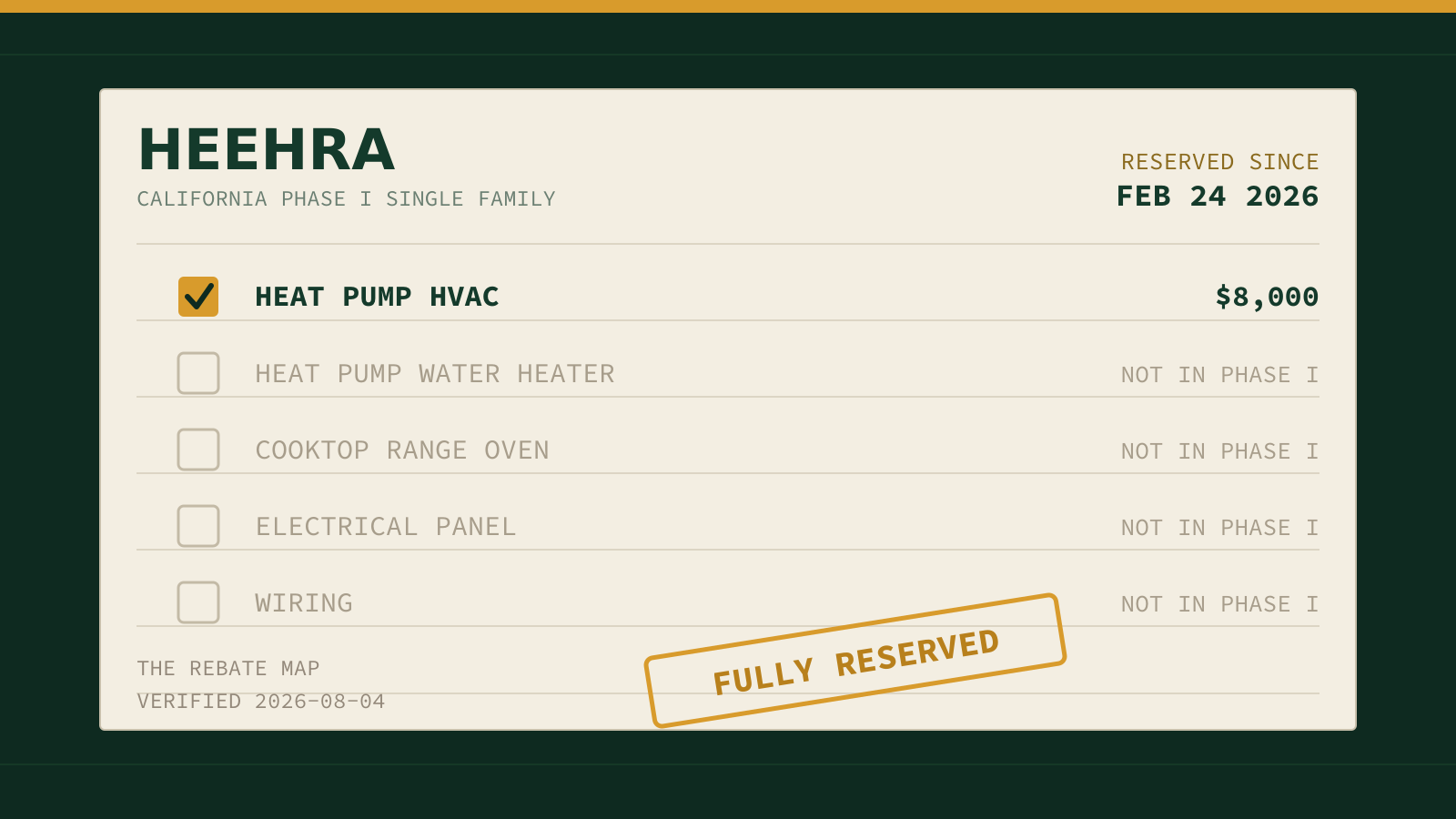
    • California. The California Energy Commission page had not addressed the May 2026 notices when we read it. For single-family applicants the binding constraint is different anyway: “As of February 24, 2026, HEEHRA rebates for single-family home retrofits are fully reserved statewide.” The page adds that “HEEHRA rebates are still available statewide for multifamily homes” and that “HOMES rebates are not yet available.”
    • New York. NYSERDA’s Inflation Reduction Act page describes EmPower+ and the Appliance Upgrade Program and made no reference to the May 2026 notices when we checked.

    One caution about the three-month clock. DOE dates both notices May 2026 with an effective date of May 29, 2026, which puts the conformance deadline for launched programs at the end of August. Georgia has published August 31. But states are setting their own application cutoffs ahead of that federal date, and Arizona’s is a full month earlier. We did not find a DOE document naming one nationwide consumer deadline. The only safe assumption is that your state’s cutoff is earlier than the federal one, not later.

    One more line from the notice is worth knowing if you are already in the queue: “Any existing, approved rebate reservations under the previous program guidance are allowed to be executed, but no new rebate reservations are allowed or can be approved for projects that do not conform to the new program strategy.” An approved reservation is the thing that protects you. An intention is not.

    Programs that have not launched get no transition at all. The notice requires that grantee programs which have not yet launched “are required to align with new program requirements prior to launching.” If your state is still in development, it will open under the new rules.

    Meanwhile, Congress is trying to end the program outright

    There is a second track, and most coverage treats it as the main one. It is not, but it is real.

    The House passed H.R. 4758, the Homeowner Energy Freedom Act, on February 25, 2026. The Clerk of the House recorded Roll Call 78 at 210 yea, 199 nay, 1 present, 22 not voting, with Republicans at 210 to 1 and Democrats at 0 to 198. A motion to recommit failed 198 to 208 the same day. The committee votes ran the same way: 16 to 14 in subcommittee on November 19, 2025, and 25 to 21 in full committee on December 3, 2025.

    The committee report puts both cases on the record. The majority wrote that “Inserting taxpayer subsidies into this system deprives the public of the beneficial forces of the free market.” The minority wrote that “The programs being repealed by H.R. 4758 are not mandates. They are optional programs that increase access to efficient appliances.”

    What the bill would and would not do

    The bill repeals three sections of Public Law 117-169: section 50122, the electrification rebate; section 50123, the state-based contractor training grants; and section 50131, assistance for building energy code adoption. It does not repeal section 50121. HOMES survives the bill entirely. The only thing the bill does to 50121 is a conforming amendment striking a cross-reference in subsection (c)(7).

    The rescission clause is narrower than the headlines suggest. It reads that “The unobligated balances of any amounts made available under each of sections 50122 and 50131 … are rescinded.” Unobligated. Money DOE has already committed to a state under a signed award is not reached by that sentence.

    The Congressional Budget Office scored the bill on January 15, 2026 and put the remainder small. CBO wrote that it “estimates that about $300 million in unobligated balances will be available for the other two programs at the time of enactment,” and noted that section 50123’s balance had already been rescinded by the 2025 reconciliation act. Set that against the statutory appropriations: 42 U.S.C. 18795a provides “$4,275,000,000, to remain available through September 30, 2031” for state electrification programs plus “$225,000,000” for Indian Tribes, and 42 U.S.C. 18795 provides “$4,300,000,000, to remain available through September 30, 2031” for HOMES. CBO also concluded the bill would not change direct spending across 2026 through 2035, because it expects those balances would not be spent under current law regardless.

    Where the bill actually sits

    It went to the Senate the day it passed. The Government Publishing Office print of the Referred in Senate version is dated February 25, 2026 and carries the line “Received; read twice and referred to the Committee on Energy and Natural Resources.”

    It has not moved since. The Senate Energy and Natural Resources Committee held a business meeting on July 16, 2026 to consider nominations and pending legislation. Nineteen measures were on that agenda. H.R. 4758 was not one of them.

    There is also a Senate companion that almost no one mentions. S. 333, also called the Homeowner Energy Freedom Act, was introduced by Senator Tim Sheehy and referred to the same committee on January 30, 2025, with six cosponsors: Barrasso, Fischer, Lankford, Marshall, Ricketts, and Schmitt. Eighteen months later it has had no committee action either.

    The arithmetic is part of the explanation. The Senate is 53 Republicans, 45 Democrats, and 2 Independents. A freestanding bill needs 60 votes to end debate, and the House tally showed no Democratic support at all to build from. That does not make repeal impossible. A provision like this can ride a reconciliation bill, where 51 is enough, and section 50123’s balance was in fact taken that way in 2025. But as a standalone measure the votes are not visibly there, and five months of committee silence is consistent with that.

    We are not predicting an outcome. We are reporting the record: passed the House, referred to committee, no action, no scheduled action.

    Which of the two actually affects your project

    This is the part that gets inverted almost everywhere. The bill is the dramatic story. The notice is the one that changes what you can get.

    The bill has not become law, has no scheduled Senate action, and even if enacted would rescind only unobligated money, roughly $300 million by CBO’s estimate, out of $8.8 billion appropriated across the two rebate programs. Every dollar already obligated to your state stays obligated.

    The notice is already in effect and has been since May 29. Your state is required to conform within three months. Several states have published their cutoffs. The earliest one we found is days away.

    If you heat with gas and you have been waiting for the right moment, the deadline that governs you was set by a document nobody mailed you.

    What to do in the next ten minutes

    • Open your state energy office rebate page, not a national one. The DOE program page says only that rebates are “now available in select states” and names no dates. Every hard deadline we found was published by a state.
    • Look for the words fuel switching, gas to electric, or electric-to-electric. If your state has posted a cutoff, it will be on that page.
    • Find out what the deadline attaches to. Georgia’s attaches to a contractor-submitted scope of work. Arizona’s attaches to your application. Neither requires the equipment to be installed by that date, but both require paperwork to be in.
    • If your state has not launched yet, assume it will launch under the new rules. There is no grandfathering for a program that was never open.
    • If you heat with gas, ask whether your state runs HOMES. It pays on whole-home energy reduction rather than on fuel type, and the electric-only rule does not apply to it.

    What we could not verify, stated plainly

    • How much of the $4,275,000,000 electrification appropriation DOE has actually obligated to states. There is no public obligation ledger. The DOE program page carries a modified date of July 8, 2026 and publishes no award or obligation totals. CBO’s roughly $300 million is the only public anchor, and CBO does not break it out between section 50122 and section 50131.
    • Whether an additive heat pump in a gas-heated home, with the furnace retained, is eligible under Notice 26-2. The notice permits retaining fossil-fuel HVAC and separately bars fuel switching, and does not reconcile the two. Georgia’s guidance implies such projects are treated as fuel switching. We found no DOE statement either way.
    • What all fifty states are doing. We verified Georgia and Arizona from official state sources and checked California and New York, whose pages had not addressed the notices as of July 29, 2026. We have not audited the rest.
    • Whether the Senate will act on H.R. 4758 or S. 333. Neither has had committee action and we found no scheduled markup for either.
    • Whether any legal challenge to the notices would succeed. Advocacy groups have argued the changes conflict with the authorizing statute. We are not in a position to assess that, and there is no ruling to report.

    Where to go next on this site

    Sources for every figure above: DOE Program Notice 26-1, DOE Program Notice 26-2, DOE Home Energy Rebates, Georgia HEAR Program Update, Efficiency Arizona, California Energy Commission, H.R. 4758 as referred to the Senate, House Roll Call 78, House Report 119-484, CBO cost estimate for H.R. 4758, 42 U.S.C. 18795, and 42 U.S.C. 18795a.

    Updated July 29, 2026: we opened the official rebate page for twenty-four states to see which ones have told homeowners that the rule changed. Only six mention it, and six more are open and still publishing the old rule.

  • The Heat Pump Tax Credit Ended. The Rebate Did Not. What Actually Applies in 2026

    The federal tax credit that helped pay for heat pumps is gone. The federal rebate that helps pay for heat pumps is not. Those are two different programs, created by two different laws, and in 2026 only one of them can still put money in your hand.

    That distinction is the most misunderstood thing in this subject, and the confusion is not the reader’s fault. On the day we checked, the first page of Google results for “is the heat pump tax credit still available 2026” contained pages published in March and April of 2026 – months after the credit had already ended – telling homeowners the credit runs through 2032 and walking them step by step through claiming it on a 2026 return.

    Last verified against official sources: July 29, 2026. Nothing here is tax advice. It is a record of what the statute, the IRS and the Congressional Budget Office actually published, with the dates we read them.

    The credit ended on a specific day, and the statute says so in one sentence

    The Energy Efficient Home Improvement Credit lives at 26 U.S.C. 25C. Its final subsection now reads, in full: “This section shall not apply with respect to any property placed in service after December 31, 2025.”

    The Residential Clean Energy Credit, at 26 U.S.C. 25D, the one that covered solar, battery storage and geothermal heat pumps at 30 percent with no dollar cap, now carries the matching sentence: “The credit allowed under this section shall not apply with respect to any expenditures made after December 31, 2025.”

    Both terminations were written by Public Law 119-21, signed July 4, 2025. You can read the current text of 26 U.S.C. 25C and 26 U.S.C. 25D yourself. The termination sentence is the last thing on each page.

    The IRS said the same thing in its own words in fact sheet FS-2025-05, dated August 21, 2025: “The credit will not be allowed for any property placed in service after December 31, 2025” for section 25C, and “The credit will not be allowed for any expenditures made after December 31, 2025” for section 25D.

    The trap is the word “paid”

    A great many contractor pages told homeowners that to qualify, the job had to be “completed and paid for” by December 31, 2025. Half of that is wrong, and it is the half that costs people money.

    For section 25D the IRS answered this directly in the same fact sheet, quoting the statute: “Section 25D(e)(8)(A) provides that an expenditure with respect to an item is treated as made when the original installation of the item is completed.” The IRS then draws the conclusion for you: if installation finishes after December 31, 2025, the expenditure is treated as made after that date, and the credit is not available.

    For section 25C the test was always the installation date rather than the purchase date. The IRS credit page, last reviewed April 28, 2026, still states it plainly: “You must claim the credit for the tax year when the property is installed, not merely purchased.”

    So the two credits use different statutory words – “placed in service” for 25C, “expenditures made” for 25D – but they arrive at the same practical test. A deposit paid in November 2025 on equipment that went in during January 2026 does not qualify under either one. Writing a check in December was never enough.

    The rebate money is a separate appropriation, and it runs to 2031

    Here is what almost nobody on the first page of Google tells you. The rebates are not a tax provision at all. They were funded by direct appropriations in the Inflation Reduction Act, they live in Title 42 rather than the tax code, and Public Law 119-21 did not touch them.

    The efficiency program at 42 U.S.C. 18795 received “$4,300,000,000” to “remain available through September 30, 2031.”

    The electrification program at 42 U.S.C. 18795a received “$4,275,000,000, to remain available through September 30, 2031” for state energy offices, plus “$225,000,000, to remain available through September 30, 2031” for Indian Tribes.

    Neither section contains a sunset clause. The Department of Energy’s own program page, last modified July 8, 2026, still opens with the sentence “Home Energy Rebates are now available in select states.”

    That is the whole answer to the question people are actually asking. The credit is over. The rebate is running. Whether you can get one depends on your state, not on your tax year.

    There is a bill to repeal the electrification rebate, and it has already passed the House

    This is the part that belongs in any honest 2026 answer, and we could not find it stated anywhere on the first page of results.

    H.R. 4758, the Homeowner Energy Freedom Act, passed the House of Representatives on February 25, 2026 by a vote of 210 to 199. The version printed by the Government Publishing Office that same day is the “Referred in Senate” print, and it carries the line “Received; read twice and referred to the Committee on Energy and Natural Resources.”

    What the bill actually does is narrow and specific. It repeals “Section 50122 of Public Law 117-169 (42 U.S.C. 18795a) (relating to a high-efficiency electric home rebate program),” along with section 50123 (contractor training grants) and section 50131 (building energy code adoption). Then it adds: “The unobligated balances of any amounts made available under each of sections 50122 and 50131 of Public Law 117-169 are rescinded.”

    Read that list again. Section 50122 is the electrification rebate – the one with the $14,000 household ceiling and the $8,000 heat pump line. Section 50121, the efficiency rebate at 42 U.S.C. 18795, is not repealed by this bill. It appears only in a conforming amendment that strikes a cross-reference.

    The word “unobligated” is doing almost all of the work

    A repeal of a program whose money is already out the door is not the same as taking the money back. The Congressional Budget Office scored this bill on January 15, 2026 and put a number on it: “CBO estimates that about $300 million in unobligated balances will be available for the other two programs at the time of enactment,” and that enacting the bill “would reduce budget authority in 2026 by about $300 million.”

    Set that against the $4.275 billion originally appropriated to state energy offices under section 50122. If CBO is right, the great majority of the electrification rebate money has already been obligated to state grantees, and a rescission of unobligated balances would not reach it.

    Two honest limits on that reading. CBO gives the roughly $300 million as a combined figure for sections 50122 and 50131 and does not break it out by program, so we cannot tell you how much of it is rebate money. And obligation to a state is not the same as a rebate reaching your kitchen – what a state does with an obligated award once its authorizing section has been repealed is a question no official document we found answers.

    We read the whole first page of Google. Here is what it told us.

    On July 29, 2026 we opened every result on the first page for “is the heat pump tax credit still available 2026” and checked each one against the statute. We are naming them because the point of this section is that you can repeat the check yourself.

    • acdirect.com, published March 17, 2026, states that section 25C continues “through at least 2032” and offers “30% of cost” up to “$2,000 per year” for heat pumps. It links to IRS.gov while contradicting it.
    • filterbuy.com, published April 16, 2026, says the credit “gives eligible homeowners 30% of qualifying heat pump costs back on their federal tax return, capped at $2,000 per year,” calls 2026 a good year to upgrade, and gives instructions for claiming it on a 2026 return.
    • environmentamerica.org, a nonprofit, carries an article updated June 30, 2024 whose body says the credit runs “through 2032” and whose own correction banner says the credits “have expired as of December 31, 2026.” The banner has the wrong year and contradicts the text below it.
    • jaymoodyhvac.com shows a last-modified date of July 2, 2026 but is still written in the future tense: “Beginning January 1, 2026, the federal tax credit for heat pump installations will no longer be available.” It also tells readers the job must be “completed and paid for” by December 31, 2025, which is the payment error described above.
    • hvacbase.org, updated July 18, 2026, gets it right, and is the only page we found that also tells the reader the rebate programs “were separately appropriated and survived the OBBBA.” It cites the IRS and a Congressional Research Service product by name but does not link to either.
    • vivavolt.us, published January 8, 2026 and modified May 27, 2026, gets it right and states the expiration date plainly.
    • beltwayhvac.com, published February 10, 2026, gets the expiration right but never mentions the state rebate programs at all, so a reader leaves believing nothing is available.
    • infinityheatingandair.com returned no substantive content on the credit when we fetched it.

    That is three pages correct, two flatly wrong, one self-contradictory, one stale in its framing, and one we could not assess. Of the seven we could read, exactly one told the reader the thing that actually matters in 2026.

    A test you can apply to any page in ten seconds

    A page that has done the work will do two things. It will give a termination date rather than an availability year, and it will link to the statute or to the IRS page it is summarizing, not merely name them. A page that says a credit runs “through 2032” without linking anything is describing the law as it stood before July 4, 2025.

    Check the byline date, then check whether the page distinguishes the tax credit from the rebate. Any page that treats them as one program has not understood the question.

    Update: the rebate is still here, but it narrowed on May 29, 2026

    This article was written before the Department of Energy issued Program Notice 26-2, effective May 29, 2026. Nothing in the notice revives the expired tax credit, and nothing in it ends the rebate. What the notice did was narrow the rebate. Fuel switching was removed from the program, so the gas-to-heat-pump conversion that the old tax credit and the rebate both once reached is being phased out of the rebate as well. Separately, a House-passed bill would repeal the rebate programs outright, though it has had no Senate action since February. Read both tracks in full.

    What we could not verify, stated plainly

    • Whether the Senate will act on H.R. 4758. Congress.gov blocks automated retrieval, so we took the bill’s status from the Government Publishing Office’s own print. The most recent official version we could find is the February 25, 2026 “Referred in Senate” text. We found no later official version and no record of Senate floor action as of July 29, 2026. This is a live bill, not a settled outcome.
    • How much of the roughly $300 million is rebate money. CBO reports it as a combined figure for sections 50122 and 50131 and does not break it out.
    • Which state awards are obligated. DOE publishes no ledger of obligations by state, so we cannot tell you whether your state’s money is inside or outside the reach of a rescission.
    • Whether any state has changed course because of the bill. Not one of the state program pages we checked mentions H.R. 4758.
    • Whether your own 2025 installation qualifies for the credit. That depends on your installation date, your documentation and your return. It is a question for a tax preparer, not for us.

    What to do in the next ten minutes

    • If your equipment was installed in 2025, dig out the invoice and find the date installation was completed, not the date you paid. That date is what the statute turns on.
    • If you are shopping now, stop looking for a federal tax credit. It is not there, and any quote built around a $2,000 credit is quoting a repealed provision.
    • Find your state’s own rebate page and read its status line. The rebate is administered by your state energy office, and whether it is open has nothing to do with the tax code.
    • Check your utility separately. Utility rebates are a third thing again, funded by ratepayers, and they were not affected by any of this.
    • Note the date on whatever page you rely on. In this subject a page more than a few months old is a liability.

    Where to go next on this site

    We track which states are actually paying, and what each one publishes in its own words, in Home Energy Rebates by State. If the number you care about is the heat pump maximum, we checked which states publish one and which do not in Is the $8,000 heat pump rebate real?. And because the rebate is income-tested in a way the credit never was, the statutory tiers are set out in the income rules behind the $14,000 rebate.

    Our sourcing rules, including why we quote statutes rather than summarize them, are in How We Source Our Data. How this site earns money is in How We Get Paid.

    Updated July 29, 2026: we opened the official rebate page for twenty-four states to see which ones have told homeowners that the rule changed. Only six mention it, and six more are open and still publishing the old rule.

  • Do You Actually Qualify? The Income Rules Behind the $14,000 Home Energy Rebate

    Almost every page about the federal home energy rebates leads with the same number: $14,000. Very few of them tell you that $14,000 is a ceiling across seven separate appliance categories, that it only applies to one of the two federal programs, and that whether you get 100 percent of your project cost, 50 percent, or nothing at all is decided by a single line in the statute about your county’s median income.

    This page sets out what the law and the federal agencies actually publish about income eligibility, and marks clearly where they publish nothing. Last verified against official sources: July 29, 2026.

    The $14,000 is a ceiling across seven categories, not an offer

    The Home Electrification and Appliance Rebates program is written into federal law at 42 U.S.C. 18795a. The statute sets a separate maximum for each qualifying measure:

    • Heat pump for space heating and cooling: not more than $8,000
    • Heat pump water heater: not more than $1,750
    • Heat pump clothes dryer: not more than $840
    • Electric stove, cooktop, range or oven: not more than $840
    • Electric load service center (your panel): not more than $4,000
    • Electric wiring: not more than $2,500
    • Insulation, air sealing and ventilation: not more than $1,600

    Add those up and you get $19,530. The statute then caps the household: a household receiving multiple rebates may receive “not more than a total of $14,000”. So $14,000 is what you would reach only by replacing several systems at once, at full published maximums, in a state that publishes those maximums, while funding is still open.

    You can read the section yourself at the U.S. Code text of 42 U.S.C. 18795a.

    The two income lines that decide everything

    The same statute sets exactly two income lines, and they do not work the way most summaries describe them. The rebate covers “100 percent of the cost of the qualified electrification project” for a household whose annual income is less than 80 percent of the area median income. It covers “50 percent of the cost of the qualified electrification project” for a household whose income is “not less than 80 percent and not greater than 150 percent” of the area median.

    Above 150 percent there is no tier. The statute simply does not describe such a household as eligible: it defines the eligible household as one whose total annual income is “less than 150 percent of the median income” for the area.

    That matters more than the dollar maximums do. If your income is above the 150 percent line, the $8,000 heat pump figure is not a smaller number for you. It is not a number for you at all under this program. You would be looking at the 25C tax credit or at a state or utility program instead, which are different things with different rules.

    The efficiency program uses completely different logic

    There is a second federal program, Home Efficiency Rebates, written at 42 U.S.C. 18795. It pays for measured or modeled whole-home energy savings rather than for specific appliances, and its income line sits at 80 percent of area median income, not 150 percent.

    For a household above that line, a project modelled to cut energy use by 20 to 35 percent is worth the lesser of $2,000 and 50 percent of project cost; at 35 percent savings or more, the lesser of $4,000 and 50 percent of cost. For a household below 80 percent of area median income, those become the lesser of $4,000 and 80 percent of cost, and “the lesser of $8,000 per single-family home or dwelling unit” and 80 percent of cost.

    This is the single largest source of confusion online, and it is worth stating plainly: $8,000 appears in both programs and means two entirely different things. In the electrification program it is the maximum for one heat pump. In the efficiency program it is the maximum for a whole-home retrofit that hits a 35 percent modelled savings target, and only for a household under 80 percent of area median income. A page that quotes “$8,000” without saying which program it means has not told you anything usable.

    What DOE itself publishes, and what it does not

    We checked what a member of the public can actually read on energy.gov today.

    The Department of Energy’s main Home Energy Rebates page carries a modification date of July 8, 2026. On income it says only that “Grantees may increase rebates for households with income less than 80% of the area median”. It gives the two headline ceilings, up to $8,000 for the efficiency program and up to $14,000 for electrification, and then directs readers to their state or territory energy office.

    DOE’s public FAQ fact sheet goes slightly further. It states in a footnote that “Only families making less than 150% of their area median income are potentially eligible”, and describes coverage as up to 100 percent for lower-income families and up to 50 percent for moderate-income families. It does not define which incomes those two labels refer to, and the document carries no revision date on its face.

    Two program-specific DOE pages we tried, the ones an ordinary search would land on for each program by name, returned 404 errors on July 29, 2026.

    So the clean tier table that dozens of commercial sites publish, 80 percent for 100 percent coverage and 80 to 150 percent for half, does not appear in plain language anywhere on DOE’s own public pages that we could find. It is in the statute. We had to read the statute to state it, which is why we have linked it above rather than asking you to trust us.

    Area median income is a county number, and it moved on May 1, 2026

    Area median income is not a state figure and not a national one. It is published per metropolitan area and per non-metropolitan county by the Department of Housing and Urban Development, and it is revised every year.

    The current set is the FY 2026 Income Limits, effective May 01, 2026. HUD’s query tool documents how the limits were built “for any area of the country selected by the user”, and it is the only place we will point you for your own number: HUD Income Limits, FY 2026.

    One practical warning about that lookup. HUD publishes the 80 percent line directly, as its “low income” limit, broken out by household size. It does not publish a 150 percent line. That figure has to be derived from the area median family income HUD documents alongside the limits. If a website hands you a confident 150 percent threshold for your county, the useful question is which median it started from and which fiscal year that median came from.

    The 40 percent low-income set-aside is gone

    If you read guidance written in 2024 or 2025, you will see repeated references to a requirement that states reserve a large share of these funds for low-income households. DOE Program Notice 26-1, issued May 29, 2026, removed the 40 percent low-income set-aside and simplified the blueprint approval process.

    It is worth being precise about what that did and did not do, because the change has been described online in both directions. It did not cancel any state’s program. It did not reduce any state’s allocation. What it removed was a federal requirement that a fixed share of the money be held for low-income households. Its companion, Notice 26-2, did make a substantive change to which projects qualify, and that is covered in the update at the end of this article. Whether a given state still prioritises low-income applicants is now that state’s decision, and several do. The notices are published at Program Notice 26-1 and Program Notice 26-2.

    Four states publish their income tiers clearly. Most do not.

    Federal law sets the tiers, but you do not apply to the federal government. You apply to a state program, and the state decides how to describe, document and verify your income.

    Of the nineteen states we track, four publish their income tiers in a form a homeowner can act on: California, Florida, North Carolina and Colorado. Their official pages are California Energy Commission, Florida HEAR, Energy Saver North Carolina and the Colorado Energy Office.

    The rest fall into two groups. Some describe the federal tiers in general terms without saying how they will be documented. Others have not published an income section at all, because their program is not open to applications yet. In neither case can we tell you what paperwork you will be asked for, and we are not going to guess.

    Where those per-state “income guide” pages come from

    Search for your state and the word “income” and you will find pages titled something like “Georgia Energy Rebate Income Guide 2026 AMI Thresholds & Eligibility”, and near-identical pages for Illinois and Michigan.

    Those three states are on our list of states that publish no heat pump maximum at all. The income thresholds on such pages are not quotes from a state program. They are HUD’s county tables multiplied by the statutory percentages. That arithmetic is not wrong, and it can be a reasonable estimate. But it is a model, not a rule a state has committed to, and it will not survive contact with an application form if the state ends up documenting income differently, using a different fiscal year, or counting household size differently.

    The tell is simple. A page quoting a state’s own rule will link to the state’s own page and say when it was read. A page publishing a derived model usually does neither.

    Income sets your rebate tier, but it had nothing to do with the federal tax credit, which carried no income test and terminated for property placed in service after December 31, 2025. The Heat Pump Tax Credit Ended. The Rebate Did Not. explains the split.

    Update: the income rules did not change, the eligible project did

    This article was written before the Department of Energy issued Program Notice 26-2, effective May 29, 2026. The income thresholds described here, which are tied to area median income, were not altered by the notice. A second test now sits alongside them. The notice removed fuel switching from the program, so qualifying on income is no longer sufficient if the project replaces a non-electric appliance. The notice also requires that a home use rebates for insulation and air sealing before heating and cooling upgrades, unless it is already sealed to a level the state has specified and DOE has approved. Read the full account of what the notice changed.

    What we could not verify, stated plainly

    • No federal page we could find publishes the 100 percent / 50 percent / 80 percent / 150 percent structure in plain language for the public. We took it from the statute.
    • Two DOE program-specific pages returned 404 on July 29, 2026.
    • DOE’s public FAQ fact sheet carries no revision date on its face.
    • We did not attempt county-level income figures for any state. There are thousands of them, they change annually, and the only correct source is HUD’s own lookup.
    • We have not verified how any state documents or audits income at application, because most have not published that.

    How to check your own position in ten minutes

    • Work out which program you are actually asking about. Appliances and panel work is the electrification program with the 150 percent line. Whole-home retrofits measured on savings is the efficiency program with the 80 percent line.
    • Look up your county in HUD’s FY 2026 income limits and find the 80 percent figure for your household size.
    • If you are under it, the statute contemplates 100 percent of project cost under the electrification program, subject to your state actually running one.
    • If you are over it, find your area’s median family income in the same HUD documentation and compare 150 percent of it against your household income.
    • Then, and only then, open your own state’s official page and check whether it is taking applications at all. That is where most of these projects actually stop.

    We keep the state-by-state status list current here: Home Energy Rebates by State: Who Is Actually Paying in 2026. If your question is specifically about the heat pump number rather than the income line, we took that apart separately in Is the $8,000 Heat Pump Rebate Real?.

    Our sourcing rules, including which kinds of sites we refuse to take dollar figures from, are set out in How We Source Our Data. How this site earns money, and what that does and does not influence, is in How We Get Paid.

    Updated July 29, 2026: we opened the official rebate page for twenty-four states to see which ones have told homeowners that the rule changed. Only six mention it, and six more are open and still publishing the old rule.

  • Is the $8,000 Heat Pump Rebate Real? What Each State Actually Publishes

    Last verified against official state sources: July 25, 2026.

    Search for a heat pump rebate and you will be told, over and over, that you can get $8,000. The figure is real. It is written into federal law. But it is not a promise, and in most states it is not a number any government agency has actually published.

    We checked 19 states one at a time, on each state’s own .gov site. Six of them publish $8,000 as the heat pump maximum. One publishes a different set of numbers entirely. Eight publish no heat pump figure at all. This page shows you which is which, and what each state’s own words are.

    Where the $8,000 comes from

    The number comes from the federal Home Electrification and Appliance Rebates program, usually shortened to HEAR. Congress funded it and the U.S. Department of Energy distributes the money, but every operational decision belongs to your state energy office: when the program opens, who administers it, what the application looks like, and in many cases what the actual rebate amounts are.

    That is the whole reason the answer is different in Georgia than it is in Texas. There is no national heat pump rebate you can apply for. There are state programs funded by a federal law, and they are at wildly different stages.

    Two DOE program notices issued on May 29, 2026 reshaped the rules mid-stream. Program Notice 26-1 covers the efficiency side and Program Notice 26-2 covers electrification. They removed the requirement that 40 percent of funds be reserved for low-income households and simplified how state implementation blueprints get approved. Notice 26-2 also removed fuel switching from the electrification rebate, which is the more consequential of the two changes and is covered in the update at the end of this article. What they did not do is cancel any state’s program or cut any state’s funding. If your state’s page says it is waiting on DOE, that is the approval queue those notices reset, not a cancellation.

    The six states that actually publish $8,000

    These states put the number on their own official pages, in their own words:

    • California publishes $8,000 for single-family households at or below 80 percent of area median income, and $4,000 for households between 80 and 150 percent. Read the important caveat about California further down this page. Source: California Energy Commission.
    • Florida publishes $8,000 for a heating and cooling heat pump, though the program is still described as a pilot expected to expand. Source: Florida Energy Saver Program, FDACS.
    • New York publishes $8,000 for an ENERGY STAR certified heat pump serving as the primary heating source, delivered through the existing EmPower+ program. Source: NYSERDA IRA rebates FAQ.
    • North Carolina publishes $8,000 for an ENERGY STAR certified electric heat pump, and has been taking applications since January 2025. Source: NC Department of Environmental Quality and the Energy Saver NC portal.
    • Virginia publishes $8,000 for heating and cooling, but has not launched. Its own FAQ says the launch depends on DOE review and approval. Source: Virginia Energy.
    • Arizona publishes $8,000 for an ENERGY STAR certified heat pump and $1,750 for a heat pump water heater, with the program described as aiming to start issuing rebates. Source: Arizona Governor’s Office of Resiliency.

    Notice that publishing the number and paying the number are different things. Of those six, only New York and North Carolina were both publishing $8,000 and actively taking applications on the day we checked.

    Colorado publishes a different set of numbers

    Colorado is the one state in our check that breaks the $8,000 pattern deliberately. Its energy office publishes a tiered structure instead: $8,000 for a cold climate heat pump, $3,000 for a standard heat pump, $1,750 for a heat pump water heater, and a household cap of $14,000 across all measures. Source: Colorado Energy Office and its rebate FAQ.

    If you live in Colorado and someone quotes you a flat $8,000, ask whether they mean the cold climate equipment. It is a meaningful difference in what you will actually be reimbursed.

    Georgia is paying, but publishes no single heat pump maximum

    Georgia has been running the most visibly active program in our check. It launched fully on March 31, 2025, and by an official press release dated April 9, 2026 the state had paid out more than $25 million to more than 1,900 households.

    What Georgia does not publish is a single heat pump maximum. Its FAQ gives efficiency rebates of $2,000 to $4,000 for an individual home and up to $400,000 for multifamily properties, but no standalone heat pump number. Source: GEFA FAQ and the April 9, 2026 press release.

    So Georgia is simultaneously the state most likely to actually pay you, and a state where nobody can honestly tell you the maximum in advance.

    The eight states that publish no heat pump number at all

    On the day we checked, these states’ own official pages gave no heat pump specific maximum. Not a range, not a cap, nothing:

    We did not estimate. We did not carry a number over from a neighboring state. If you see a confident dollar figure attached to any of these eight, ask the person quoting it which official page it came from.

    The Texas trap

    Texas deserves its own warning, because the mistake is so easy to make. The Texas SECO page does contain a dollar figure: $2,000 per year. That figure is the federal 25C tax credit, which is a completely different mechanism from a HEAR rebate.

    A tax credit reduces what you owe the IRS when you file, using Form 5695. A rebate is money taken off the price at the time of the work, or reimbursed to you afterward by a state program. You can potentially use both, but they are not the same thing and they do not stack into a single $8,000 discount at the counter. Texas’s own page currently says both the efficiency and electrification rebate programs are not available.

    Ohio: we could not verify anything

    We looked for an official Ohio .gov page stating the status, the amounts, the income thresholds, or even the responsible agency for these programs, and we did not find one. Searches on the Ohio Department of Development site returned other energy assistance programs such as LIHEAP, but no dedicated page for these rebates.

    We are not going to guess on Ohio’s behalf. If you live in Ohio, calling the state energy office directly will get you a better answer than any website currently offers, including this one.

    Two places where $8,000 is published and the money is already gone

    This is the part almost nobody tells you, and it is the single most expensive thing to get wrong.

    California. The California Energy Commission’s page states that as of February 24, 2026, these rebates for single-family home retrofits are fully reserved statewide. The published $8,000 is still on the page. The queue for single-family homes is closed. Multifamily Phase I remained open. Source: California Energy Commission.

    Colorado Region 1. The Colorado Energy Office states that Region 1, the Front Range metro area, is now closed, and that household applications and project proposals submitted after April 27, 2026 for Region 1 will not be reviewed. Region 2 remained open, scheduled to run until August 1, 2026 or until funds are exhausted, whichever comes first. Source: Colorado Energy Office.

    If you are in the Front Range and reading this after August 2026, check Region 2’s status before you plan around it. That deadline was days away when we verified this page.

    The income lines that decide your amount

    The federal structure has three tiers, and they matter more than the headline number:

    • At or below 80 percent of area median income, you can generally qualify for the full rebate.
    • Between 80 and 150 percent of area median income, you generally qualify for roughly half.
    • Above 150 percent of area median income, you are generally not eligible for this particular rebate at all, though the 25C tax credit may still be available to you.

    Only four of the states we checked publish these tiers clearly on their own pages: California, Florida, North Carolina, and Colorado. Texas, New Jersey, Michigan, Wisconsin, Maryland, Arizona, and Virginia do not lay out the same explicit percentage breakdown, so in those states you will need the administering agency to tell you where you fall.

    Area median income is county specific. A household income that qualifies in one county can fail in the next county over. Do not rely on a statewide figure.

    The statutory text behind those three tiers, and the reason the same $8,000 figure means two different things in the two federal programs, is set out in the income rules behind the $14,000 rebate.

    If you came here because you read that the 8,000 dollar figure was a tax credit, it is not, and the tax credit that did exist ended on a date written into the statute. The Heat Pump Tax Credit Ended. The Rebate Did Not. lays out which one still applies in 2026.

    Update: the 8,000 dollar ceiling survived, the eligible project did not

    This article was written before the Department of Energy issued Program Notice 26-2, effective May 29, 2026. The 8,000 dollar heat pump line item is untouched in statute at 42 U.S.C. 18795a, and no state on this page has cut it. What changed is which project qualifies. The notice removed fuel switching from the program, so replacing a gas furnace with a heat pump is being phased out, and rebates are directed instead at upgrades from existing electric equipment to more efficient electric equipment. Arizona has asked applicants to apply by August 1, 2026 and Georgia stops accepting scopes of work on August 10, 2026 under the older rules. Read what the notice says and where each state now stands.

    What we could not verify, stated plainly

    • DOE’s own state-by-state status tracker, at the URL widely cited by third-party trackers, returned a 404 error every time we tried it. DOE’s current program page says details on active state programs are coming soon. There is no working official national status page right now.
    • We declined to use third-party trackers as a source of numbers, including the well-known 50-state analyses. They may well be accurate. They are not the state’s own words, which is the standard this site holds itself to.
    • Massachusetts is our least confident entry. The most recent official material we could locate was a 2024 straw proposal, not a 2026 status page. Treat Massachusetts here as stale and verify directly.
    • Eight of the state pages we read carry no last-updated date at all: Texas, Florida, Michigan, Arizona, New Jersey, Oregon, Wisconsin, and Georgia’s FAQ. We recorded what those pages said on July 25, 2026, and we cannot tell you how old that text was.

    How to check your own state in ten minutes

    • Search for your state’s name plus energy office, and open only the result ending in .gov.
    • Find the page for home energy rebates, and read the status sentence before you read any dollar amount.
    • Check whether the page distinguishes the efficiency program from the electrification program. They open on different schedules and pay for different things.
    • Look for a last-updated date. If there is not one, assume the page may be months behind.
    • Confirm the income tier that applies to your county, not your state.
    • Then, and only then, talk to a contractor about the equipment.

    If your state is not open yet, there is nothing to apply for, and any company telling you otherwise is selling something.

    For more on where these figures come from and how we handle numbers that agencies have not published, see How We Source Our Data. For the full state-by-state status picture, including which states are open and which are only piloting, see Home Energy Rebates by State. Our business model is described in full on How We Get Paid.

    Updated July 29, 2026: we opened the official rebate page for twenty-four states to see which ones have told homeowners that the rule changed. Only six mention it, and six more are open and still publishing the old rule.

  • Home Energy Rebates by State: Who Is Actually Paying in 2026

    Last verified against official sources: July 25, 2026.

    If you have searched for a heat pump rebate, you have probably read that you can get up to $8,000. That number is real, but it is not a promise. Whether you can get it depends almost entirely on which state you live in, and as of July 2026 roughly half the states in this country are not paying it out at all yet.

    This page is the map. It explains what the money actually is, who decides, and where each state stood on the day we last checked it against that state’s own website.

    There is no single “home energy rebate”

    What people call the home energy rebate is really a stack of separate programs that happen to pay for similar things.

    • The federal tax credits (25C and 25D). These come off your federal income tax, you claim them yourself on IRS Form 5695, and they do not depend on your state. They are a credit, not cash at the register.
    • HOMES, officially the Home Efficiency Rebates. Federal money from the Inflation Reduction Act, paid out by your state, based on how much energy your whole-home retrofit saves.
    • HEAR, officially the Home Electrification and Appliance Rebates. Also federal IRA money paid out by your state, but tied to specific equipment: heat pumps, heat pump water heaters, electrical panels, wiring, insulation.
    • Your state’s own programs. Some states run rebates funded by state money that have nothing to do with the IRA. Washington’s state-level HEAR program is a well-known example, and its own page is explicit that it is a different thing from the federal HOMES program.
    • Your utility’s rebates. Separate again, with its own rules, its own forms, and often its own contractor list.

    The $8,000 figure almost always refers to HEAR, and HEAR is the one that varies most by state.

    The federal government funds it. Your state decides everything else.

    This is the part most rebate pages skip, and it is the reason so many people come away confused.

    Congress appropriated the money. The U.S. Department of Energy administers it. But DOE does not send you a check. Each state energy office had to apply to DOE, get approved, design its own program, and then launch it. That means the income tiers, the equipment list, the maximum amounts, the contractor requirements, and the launch date are all state decisions.

    So “is there a heat pump rebate” is not a federal question. It is a question about your state energy office.

    Why so many state pages say “awaiting DOE approval”

    If you visit five state energy office pages in a row, you will notice the same sentence keeps appearing in different words: the program cannot launch until DOE signs off. Pennsylvania’s environmental protection department put it plainly, saying it is awaiting final DOE approval to launch. Oregon went further and said DOE had paused approvals while it reviewed agency priorities. Minnesota said there is no estimated launch date at all.

    There is a specific reason for this. On May 29, 2026, DOE issued two documents, Program Notice 26-1 for the Home Efficiency Rebates and Program Notice 26-2 for the Home Electrification and Appliance Rebates. They removed the Justice40 requirement that had reserved forty percent of funds for low-income households, and they simplified the blueprint approval process states had to go through. They also did something larger that drew far less attention. Notice 26-2 removed fuel switching from the electrification rebate, so replacing a non-electric appliance with an electric one is no longer an allowed use of the money. See the update at the end of this article.

    What the notices did not do is cancel any state’s program or cut the overall funding. That distinction matters, because the wave of “not yet available” language on state websites through 2026 is a symptom of a changed approval rhythm at DOE, not of a program being shut down. If your state’s page says it is waiting, waiting is the accurate reading.

    Where each state stands

    Below is what each state’s own website said the last time we checked it. Nineteen states are covered here; the rest are being added as we verify them one at a time. We do not fill gaps from third-party trackers, so if a state is missing it is because we have not read its official page yet, not because nothing is happening there.

    Taking applications now

    • Georgia. Fully launched March 31, 2025. As of an April 9, 2026 press release, the Georgia Environmental Finance Authority reported more than $25 million paid out to more than 1,900 households.
    • North Carolina. Both programs launched January 2025, with paper applications accepted from March 1, 2025. The Department of Environmental Quality publishes an $8,000 maximum for an ENERGY STAR certified electric heat pump.
    • Wisconsin. HOMES launched August 1, 2024. HEAR Phase 1 for contractor-installed equipment launched December 18, 2024, and Phase 2 for retail purchases in September 2025.
    • Michigan. Both the HOMES and HEAR halves of the MiHER program are accepting applications through the Department of Environment, Great Lakes, and Energy.
    • New York. HEAR incentives only, delivered through the existing EmPower+ program, with $8,000 for an ENERGY STAR certified heat pump used as the primary heating source. NYSERDA’s own FAQ states this is currently the only IRA home energy rebate available in the state.
    • Washington. The state-level HEAR program is open, with the Department of Commerce saying rebates are available. Note that this is a Washington program, and its page says so explicitly; it is not the federal HOMES program.
    • Colorado, Region 2 only. See the section below on money running out.
    • California, multifamily only. See the same section.

    Piloting, or partially live

    • Florida. The Department of Agriculture and Consumer Services describes a HEAR pilot expected to launch, with the full program expected early the following year. It publishes an $8,000 heat pump figure.
    • Arizona. The Governor’s Office of Resiliency describes the program as aiming to start issuing rebates. It publishes $8,000 for an ENERGY STAR certified heat pump and $1,750 for a heat pump water heater.
    • Illinois. HOMES is in a pilot stage with two local administering agencies and funding disbursed, awaiting final DOE approval. HEAR has not yet been processed by DOE for Illinois EPA to administer.

    Announced, but not open yet

    Texas, Pennsylvania, Oregon, Minnesota, Maryland, Virginia, New Jersey, and Massachusetts all had official pages saying their programs were not available. Maryland’s case is the furthest along of these: DOE has conditionally approved both of Maryland’s applications, but the Maryland Energy Administration says additional DOE approvals are still required before funding is received.

    Could not verify

    • Ohio. We could not find an Ohio state government page that states the launch status, the heat pump maximum, the income thresholds, or even which agency is responsible. Searching development.ohio.gov surfaced LIHEAP and other energy assistance programs, but no IRA HOMES or HEAR page. We are not going to guess. If you live in Ohio, calling the state energy office directly is currently more reliable than anything published online.

    Two states where the money has already run out

    This is the failure mode nobody warns you about. These programs are funded from a fixed pot, not an entitlement, and when the pot empties the program closes even though the rules on the page still describe you as eligible.

    • California, single-family. The California Energy Commission states that as of February 24, 2026, HEEHRA rebates for single-family home retrofits are fully reserved statewide. Multifamily Phase I remains open. California publishes $8,000 for households at or below 80% of area median income, $4,000 for 80 to 150%, and up to $14,000 per unit for multifamily.
    • Colorado, Region 1 (the Front Range). The Colorado Energy Office states that Region 1 is now closed, and that household applications and project proposals submitted after April 27, 2026 for Region 1 will not be reviewed. Region 2 was still accepting applications, scheduled to run until August 1, 2026 or until funds are exhausted, whichever comes first.

    Across the nineteen states we verified, these are the only two official funding-exhaustion notices we found. Several other states have not launched yet, so the question does not arise for them.

    If you are in a state that is currently open, the practical lesson is that the queue matters. A program that is open in July may not be open in October.

    What the maximum heat pump rebate actually is

    Where a state publishes a heat pump number on its own website, here is what it says.

    • $8,000 for a qualifying heat pump: California (at or below 80% AMI), Florida, New York, North Carolina, Virginia, and Arizona.
    • Colorado splits it: $8,000 for a cold climate heat pump, $3,000 for a standard heat pump, $1,750 for a heat pump water heater, with a $14,000 total cap per household.
    • Arizona also publishes $1,750 for a heat pump water heater.
    • Georgia does not publish a single heat pump maximum. Its FAQ describes Home Efficiency Rebates of $2,000 to $4,000 for an individual home, and up to $400,000 for a multifamily building.

    And here is the part other sites will not tell you. The following states have not published a heat pump specific maximum on their official pages at all: Texas, Illinois, Michigan, New Jersey, Massachusetts, Wisconsin, Maryland, and Minnesota. Texas’s page lists $2,000 per year, but that is the 25C federal tax credit, not a HEAR rebate, and treating it as one is a mistake we have seen repeated on a lot of rebate sites.

    If you see a confident dollar figure for one of those eight states, ask where it came from.

    We took that question apart state by state, quoting each state’s own page and naming all eight of them: Is the $8,000 heat pump rebate real? What each state actually publishes.

    The 80 percent and 150 percent lines

    Most states that have published their income rules use the same two thresholds, measured against area median income for your county.

    • At or below 80% of AMI, you generally get the full rebate.
    • Between 80% and 150% of AMI, you generally get half.
    • Above 150% of AMI, you generally do not qualify for HEAR at all, though HOMES is often open to all income levels with enhanced amounts for lower-income households.

    California, Florida, North Carolina, and Colorado publish this structure clearly. Virginia publishes the 150% ceiling but not the tier percentages. Washington uses 150% of AMI based on HUD county data. Texas, New Jersey, Michigan, Wisconsin, Maryland, and Arizona have not published tier percentages with the same clarity, and Massachusetts’s tiers come from a 2024 proposal document that we could not confirm was ever finalized.

    Area median income is a county-level number, not a state-level one, so a household income that qualifies in one county can fail in the next county over.

    Those two thresholds come from federal statute, not from any state, and they are applied differently in the two federal programs. We set out the exact statutory language, and what DOE does and does not publish about it, in the income rules behind the $14,000 rebate.

    One more distinction matters before you read the state tables: the federal tax credit and the state rebate are not the same money, and only one of them ended. Section 25C stopped applying to property placed in service after December 31, 2025, while the rebate appropriation runs through September 30, 2031. We worked through both in The Heat Pump Tax Credit Ended. The Rebate Did Not..

    Update: DOE removed fuel switching on May 29, 2026

    This article was written before the Department of Energy issued Program Notices 26-1 and 26-2, both effective May 29, 2026. The notices removed fuel switching from the federal home electrification rebate: rebates now apply to upgrades from existing electric equipment to more efficient electric equipment, and replacing a non-electric appliance is no longer an allowed use of the money. Every state program described on this page is affected. Programs that have already launched have three months from publication to conform, and two states have published cutoffs inside that window, with Arizona asking applicants to apply by August 1, 2026 and Georgia refusing scopes of work after 10:00 am ET on August 10, 2026. The dollar ceilings written into statute did not change. Read the full account of the two notices and the state deadlines.

    What we could not verify, stated plainly

    • DOE no longer publishes a state-by-state status tracker. The page that used to live at energy.gov/scep/home-energy-rebates-program-status-state-applications returns a 404. We tried three times. DOE’s current program page says details on active state, territory or Tribal rebate programs are coming soon, which is DOE confirming that it does not currently publish this itself.
    • The widely circulated fifty-state trackers are third-party work by think tanks and industry groups. They may well be accurate. They are not primary sources, and we did not use their numbers.
    • Massachusetts is our least confident entry. The most recent official material we could locate is a 2024 straw proposal and public comment document. If you are in Massachusetts, check mass.gov directly rather than trusting this page.
    • Several state pages carry no last-updated date at all, including Texas, Florida, Michigan, Arizona, New Jersey, Oregon, and Wisconsin. Where that is the case we have said so rather than inferring a date from a copyright footer.

    How to check your own state in ten minutes

    • Search for your state’s name plus “energy office” and open the result ending in .gov. Not the first result, the .gov one.
    • Look for a page named Home Energy Rebates, HOMES, HEAR, or IRA rebates.
    • Find the status sentence before you look at any dollar figure. Open, pilot, or waiting on DOE.
    • If it is open, find the application portal and check whether funds are still available, not just whether the page exists.
    • Check your county’s area median income, not your state’s.
    • Then, and only then, call a contractor. Going in the other order is how people end up paying for equipment on the assumption of a rebate that is not available where they live.

    We publish how we source our data and how this site makes money, because on this topic you should not take anyone’s numbers on faith, including ours.

    Updated July 29, 2026: we opened the official rebate page for twenty-four states to see which ones have told homeowners that the rule changed. Only six mention it, and six more are open and still publishing the old rule.

The Rebate Map

Home energy rebates, verified state by state

This site is independent. It is not affiliated with, endorsed by, or operated by the U.S. Department of Energy, the Internal Revenue Service, the U.S. Environmental Protection Agency, the ENERGY STAR program, any state energy office, or any electric or gas utility. Information here is general and is not legal, tax, or financial advice. Rebate amounts, income limits, and eligibility rules change — always confirm with the agency or utility that administers the program before you act.

About & Editorial Standards  ·  How We Get Paid  ·  How We Source Our Data  ·  Privacy Policy  ·  Contact

© 2026 TheRebateMap.com. Every figure is cited to a primary source — federal statute, DOE or IRS guidance, a state energy office, or a utility program document — and dated on the page where it appears.