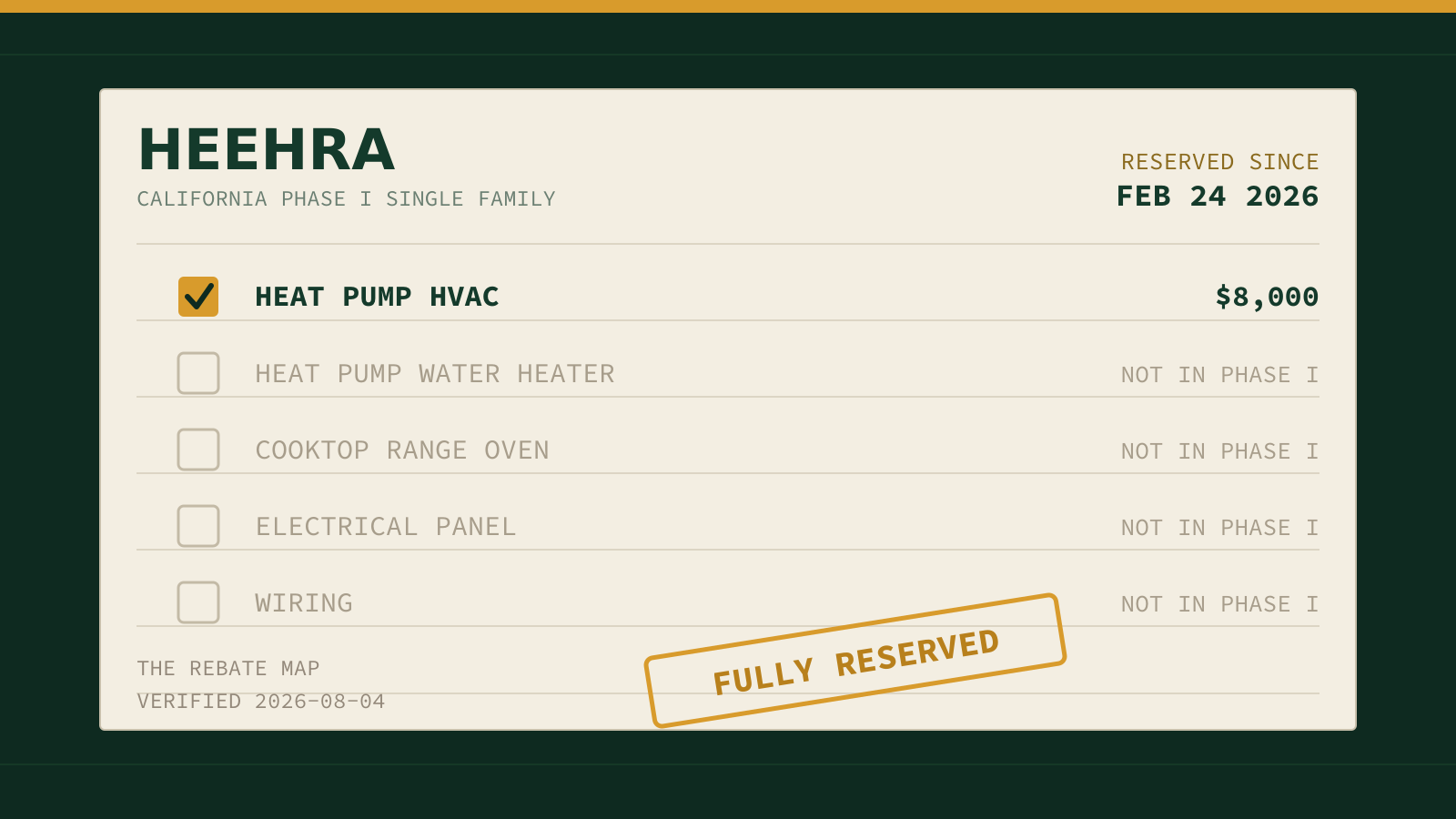
California’s HEEHRA rebate for single-family homes has been fully reserved since February 24, 2026. The California Energy Commission states it plainly at the top of its rebate page: “As of February 24, 2026, HEEHRA rebates for single-family home retrofits are fully reserved statewide. All reservation requests that have not been approved have been put on a waitlist in case budget becomes available again. No new income verification requests are being accepted at this time.”
Three separate facts are packed into that paragraph, and they are worth separating because they lead to different actions.
The rebates are reserved, not spent. Reservations are approvals attached to projects that may or may not get built. Requests that were submitted but never approved were moved to a waitlist rather than denied. And the income verification pipeline — the first step for anyone starting fresh — is closed, which means there is currently no way to enter the queue at all.
That last one is the practical answer for most people reading this. If you have not already been through income verification for HEEHRA, you cannot start today. The waitlist is populated from requests already in the system.
What HEEHRA covers, and what it does not
Here is where California differs from almost every other state running the same federal program, and where most national summaries get it wrong.
The California Energy Commission describes the single-family program in one sentence: “The HEEHRA Phase I Program provides up to $8,000 in rebates to income-qualified, California homeowners for the installation of a new, energy efficient heat pump HVAC system.”
Heat pump HVAC. That is the whole single-family menu.
The federal Home Electrification and Appliance Rebates framework authorizes a much longer list — heat pump water heaters at $1,750, electric cooktops and ranges at $840, electrical panel upgrades at $4,000, wiring at $2,500, insulation and air sealing at $1,600, with a $14,000 household total. Colorado publishes all of those. North Carolina publishes all of those. California’s Phase I, for single-family homes, publishes one: the space heating and cooling heat pump, capped at $8,000.
So if you came to this page because you read that there is “$14,000 in home electrification rebates” and you want a heat pump water heater or a panel upgrade in a California single-family home, the answer under HEEHRA Phase I is no — regardless of the waitlist, and regardless of your income.
California’s multifamily track is the opposite. The Energy Commission writes that the program “is also providing up to $14,000 per unit in rebates to income-qualified multifamily properties for heat pumps for space heating and cooling, heat pump water heaters, cooktops, ranges, overs, and heat pump clothes dryers, as well as electrical equipment such as electrical panel upgrades and w[iring].” (The “overs” is the state’s own typo for ovens.)
| Single-family, Phase I | Multifamily | |
|---|---|---|
| Maximum | $8,000 | $14,000 per unit |
| Space heating and cooling heat pump | Yes | Yes |
| Heat pump water heater | Not in Phase I | Yes |
| Cooktops, ranges, ovens | Not in Phase I | Yes |
| Heat pump clothes dryer | Not in Phase I | Yes |
| Electrical panel upgrade | Not in Phase I | Yes |
| Wiring | Not in Phase I | Yes |
The gap is not subtle. A multifamily unit in California can access the full federal appliance menu at $14,000; a single-family house next door can access one appliance at $8,000. The state has not published a rationale for the split on this page, and we are not going to invent one. What matters for a homeowner is that “California has a $14,000 rebate” is a true sentence about the wrong housing type.
The reservation rule, and why the waitlist is not a queue you can join
California’s language on this is as firm as Colorado’s: “Projects must have an approved reservation (preapproval) or will not be funded with HEEHRA.”
This is a preapproval program. Work performed without an approved reservation is not retroactively covered. Buying and installing a qualifying heat pump in July 2026 and then applying does not produce a rebate — it produces an out-of-pocket heat pump.
The second gate is the contractor. “HEEHRA rebates are only available through TECH-certified and HEEHRA-trained contractors.” A licensed HVAC contractor is not automatically eligible to run a HEEHRA project; the contractor needs the specific certification and training. When you eventually call around, this is the first question to ask, before price.
The waitlist itself is described conditionally — requests are held “in case budget becomes available again.” Budget becoming available again, in a reservation-based program, usually means reservations expiring or projects being cancelled, freeing money that was allocated but never drawn. There is no published figure for how much has come back, no published position numbers, and no published estimate of when or whether the waitlist will move. Under our rule of never printing a number we have not read on an official page, we will say directly: California does not publish those figures, and anyone quoting you a waitlist position or a reopening date is not getting it from the Energy Commission.
Meanwhile, the state continues to work through what is already approved: “The HEEHRA Phase I Program continues to process and finalize rebate applications of completed projects with approved reservations for both single-family and multifamily properties. Funds are limited.”
Phase II
The Energy Commission’s entire published statement on the next phase is: “HEEHRA Phase II rebate availability will be announced at a later date.”
That is all there is. No date, no budget figure, no indication of whether Phase II will keep the single-appliance single-family structure or open the full menu. Anyone telling you when Phase II opens, or what it will cover, is speculating.
One structural fact does constrain it, though, and it is a federal one. On May 29, 2026, the Department of Energy issued Program Notice 26-2, which removed fuel switching from the Home Electrification and Appliance Rebates program. Under the notice, HEAR money applies to replacing existing electric equipment with higher-efficiency electric equipment. The dollar caps were untouched. Programs already launched were given three months — to August 29, 2026 — to comply, with existing approved reservations permitted to execute.
A Phase II announced after August 29 would be a new launch under the new rule. Whatever California opens next cannot pay a household to move off gas. That is a significant thing for a state whose building decarbonization policy has been organized around exactly that transition for a decade.
We searched the full text of the Energy Commission’s rebate page on August 4, 2026 for “fuel switch,” “Program Notice,” “26-2,” “non-electric,” and “existing electric.” None of them appear. California has published nothing about the change on the page a homeowner would actually find. That is consistent with what we see nationally — across twenty-four state programs, none publish the August 29 federal date — but it means a Californian on the waitlist is waiting for a program whose rules have changed underneath it without notice on the state’s own page. We have written up what Program Notice 26-2 actually changed separately.
HOMES: the other half of California’s money, not yet spendable
California’s page states it in four words: “HOMES rebates are not yet available.”
HOMES — the Home Efficiency Rebates track — is the whole-home performance program that pays on measured or modeled energy savings rather than on named appliances. California’s Department of Energy award for it is $291 million, and the state has published how that award is split:
| Allocation | Share | Amount |
|---|---|---|
| Equitable Building Decarbonization Direct Install | 60% | $130.3 million |
| Pay for Performance | 40% | $90.8 million |
| Total DOE HOMES award | $291 million |
The two halves work very differently. Direct Install means the program pays for and installs the work in qualifying households rather than reimbursing them — no homeowner outlay, no reservation to chase, but participation is by program selection rather than application in most designs. Pay for Performance is the more familiar model: a contractor or aggregator delivers modeled or measured savings and is paid against them.
Neither is open. California publishes no launch date for either on this page.
That is a large amount of unspent money, and it is worth keeping in view alongside the HEEHRA waitlist. A California household that cannot get a HEEHRA reservation is not out of federal rebate money in principle — it is out of the one track that opened first and closed fastest.
Regional funding differences
One nuance the Energy Commission flags but does not resolve on its own page: HEEHRA funding availability varies by region, and the detail lives with the program administrator rather than with the state. The Commission points readers to TECH Clean California’s incentives page at `techcleanca.com/incentives/` and to TECH Clean California’s Budget Report.
If you are trying to establish whether anything at all is moving in your specific part of the state, that report is the primary document, not the Energy Commission page. It is also where the numbers change most often.
The scam warning is not boilerplate
The Energy Commission’s page carries a prominent block headed “WATCH OUT FOR IRA REBATE SCAMS!” and points to the California Department of Consumer Affairs at 1-800-952-5210.
Take that seriously in the current situation specifically. A statewide program that is fully reserved, with a waitlist that does not publish positions and a Phase II with no announced date, is an ideal environment for someone to call and offer to move you up the list, expedite your income verification, or lock in a rebate for a deposit. None of those things exist. Income verification is not being accepted at all right now. There is no expediting mechanism published anywhere.
The legitimate path has exactly two components: a TECH-certified and HEEHRA-trained contractor, and an approved reservation issued by the program. Anyone offering a third thing is offering something the program does not have.
If you are a California homeowner right now
If you hold an approved reservation: you are in the strongest position available. The state says it is continuing to process and finalize completed projects with approved reservations. Get the work completed and documented; “funds are limited” is the state’s phrasing, and reservations are not immortal.
If you are on the waitlist: stay on it, but do not plan around it. There is no published movement, no published position, no published reopening date. Treat the waitlist as an option that may become valuable, not as a funding source you can schedule a project against.
If you have not entered the system: you cannot right now — income verification requests are not being accepted. Your realistic routes are the federal tax credit, which operates on an entirely different mechanism and does not depend on state budget at all, and the utility and local programs that sit outside HEEHRA. We lay out the difference between the credit and the rebate in tax credit versus rebate.
If you want anything other than a space-heating heat pump: Phase I single-family does not cover it, waitlist or no waitlist. Water heaters, panels, wiring, and cooking appliances are multifamily-only in California’s current program.
If you own or manage multifamily property: you have access to the full $14,000-per-unit menu that single-family households do not, and the same reservation and contractor rules apply. This is the more valuable side of California’s program by a wide margin.
Bookmark the right page. The URL many people saved earlier this cycle, `energy.ca.gov/programs-and-topics/programs/home-energy-rebate-programs`, now returns a 404. The live page is `energy.ca.gov/programs-and-topics/programs/inflation-reduction-act-residential-energy-rebate-programs`.
Where California sits nationally
California closed its single-family HEEHRA pool in February 2026. Colorado’s single-family HEAR funding reached $0 in both regions in early August 2026. North Carolina’s program is still taking applications and still paying rebates as an instant discount at the contractor.
Same federal program, three completely different states of play, and none of the three publishes the federal compliance date that will reshape all of them on August 29. That is the case for checking one state’s own pages, on the day you need the answer, rather than a national roundup. We keep a state-by-state record with the date each program page was read, for exactly that reason.
Sources
Every figure and quotation above was read directly from the California Energy Commission’s page on August 4, 2026:
- `https://www.energy.ca.gov/programs-and-topics/programs/inflation-reduction-act-residential-energy-rebate-programs`
Where the state does not publish something — waitlist positions, a Phase II date, a HOMES launch date — this article says so rather than estimating.