North Carolina’s Energy Saver NC program is still open, still accepting applications, and still paying its Home Electrification and Appliance Rebates as an instant discount at the contractor. That already makes it an outlier: California’s single-family pool has been fully reserved since February and Colorado’s reached $0 in both regions in early August.
It is also, as of August 4, 2026, still publishing a rule the federal government retired on May 29: “Rebates are available only when upgrading from a non-electric appliance.”
That sentence is what most coverage of North Carolina’s program latches onto, and read on its own it suggests the whole program is on a collision course with the Department of Energy’s compliance deadline of August 29, 2026. Read in context — that is, read as a footnote with a specific marker attached to specific rows — it means something much narrower, and much more useful.
The footnote everyone reads wrong
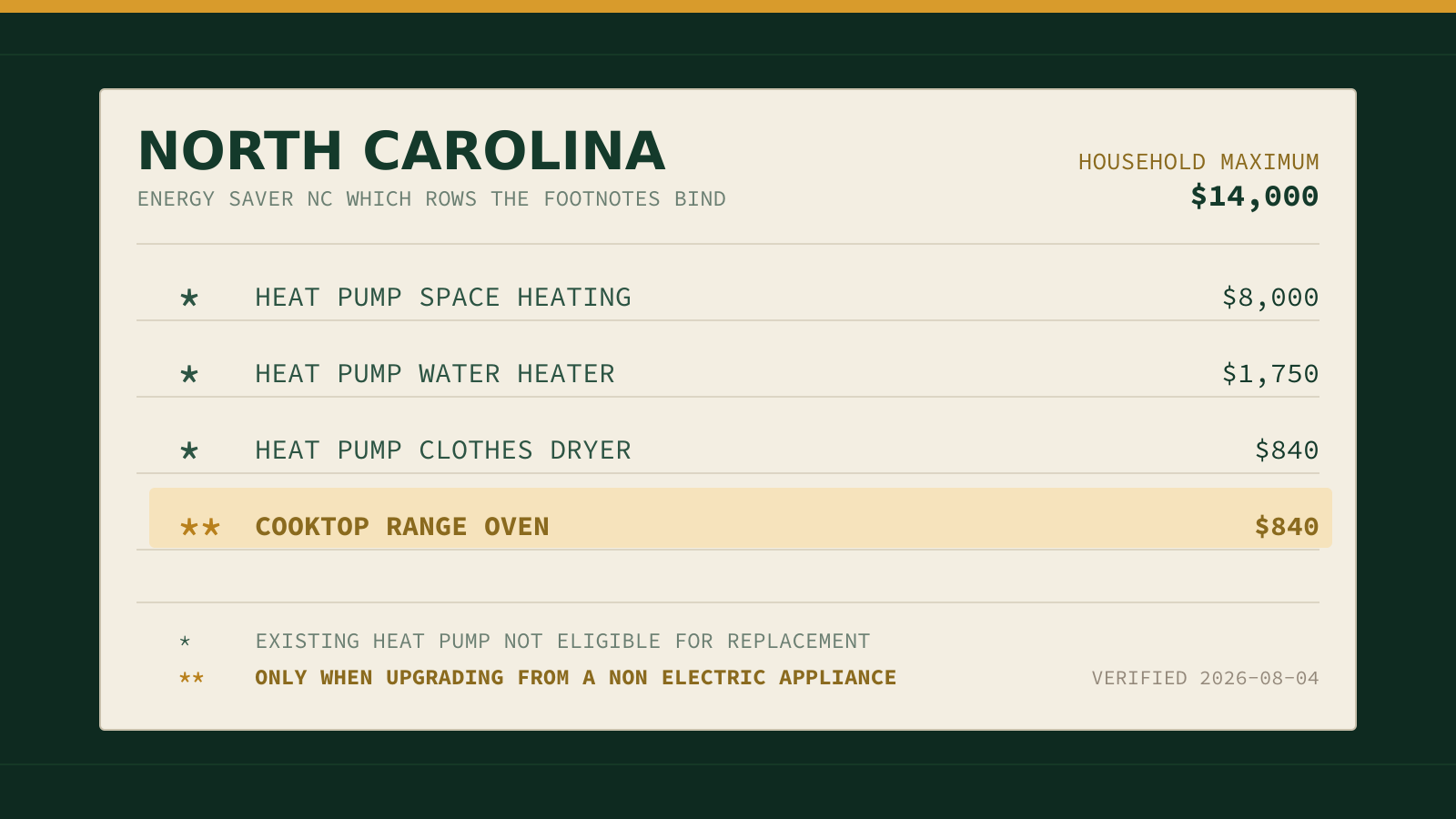
North Carolina’s rebate amounts are published as a table, and the table is an image rather than HTML. That is why the numbers below do not turn up in a text search of the page, and it is probably part of why the footnote structure gets flattened in secondary coverage.
The table carries three distinct footnote markers, and they attach to different rows.
| Upgrade | Maximum rebate | New construction eligible | Quantity limit | Footnote |
|---|---|---|---|---|
| Heat pump for space heating | $8,000 | Yes | One System | * |
| Heat pump water heater | $1,750 | Yes | 1 | * |
| Heat pump clothes dryer or combo washer/dryer | $840 | Yes | 1 | * |
| Cooktop, stove, range or oven | $840 | Yes | 1 | ** |
| Insulation, air sealing and/or ventilation | $1,600 | No | — | — |
| Electrical panel improvements | $4,000 | No | — | *** |
| Electrical wiring | $2,500 | No | — | *** |
| Maximum rebate | $14,000 |
The three footnotes read as follows.
\* — “Existing Heat Pump will not be eligible for replacement.”
**\*\*** — “Rebates are available only when upgrading from a non-electric appliance.”
**\*\*\*** — “Rebates are available only when required to enable installation of an eligible appliance on the same application. Some examples include upgrading to a 200A electrical panel, installing an electrical load management device to avoid an electrical panel upgrade and/or wiring a new electric outlet to accommodate an electric cooktop or heat pump water heater.”
Now put them back where they belong. The non-electric requirement — the one that conflicts with the federal notice — carries the double asterisk, and the double asterisk appears on exactly one row: cooktop, stove, range or oven.
The heat pump rows carry the single asterisk, and the single asterisk says something entirely different. It does not require that you be coming off a non-electric appliance. It only excludes replacing a heat pump you already have.
Why that distinction decides your project
Think about what the single-asterisk rule permits. If your house has electric resistance heat — baseboards, a furnace with electric strip heat, a wall unit — and you want to install a heat pump, North Carolina’s footnote does not stop you. You are not replacing an existing heat pump. You get the $8,000 line.
That is precisely the transaction the Department of Energy’s Program Notice 26-2 preserved. The notice, effective May 29, 2026, removed fuel switching from HEAR: rebates now apply to replacing existing electric equipment with higher-efficiency electric equipment, with the dollar caps left unchanged. Electric resistance to heat pump is the textbook qualifying upgrade under the new rule.
So North Carolina’s largest rebate line — the $8,000 space-heating heat pump, which is the reason nearly everyone visits this program — is already structured in a way that survives the federal change. The state did not have to do anything for that to be true; the heat pump footnote was never a fuel-switching requirement to begin with.
Similarly, the heat pump water heater at $1,750 and the heat pump clothes dryer at $840 carry the single asterisk. An electric-resistance tank water heater replaced with a heat pump water heater is an existing-electric-to-higher-efficiency-electric upgrade, which is what 26-2 wants.
The genuine exposure is the $840 cooking appliance line. That row, and only that row, still says the rebate is available only when you are coming off a non-electric appliance — which is to say, only when you are switching a gas range to electric. That is fuel switching. That is what the federal notice removed.
| Row | Current NC condition | Compatible with Program Notice 26-2? |
|---|---|---|
| Heat pump for space heating | No existing heat pump | Yes — electric resistance to heat pump qualifies |
| Heat pump water heater | No existing heat pump | Yes |
| Heat pump clothes dryer | No existing heat pump | Yes |
| Cooktop, stove, range or oven | Must upgrade from non-electric | No — this is fuel switching |
| Insulation, air sealing, ventilation | None | Not affected |
| Panel and wiring | Must enable an eligible appliance | Follows whichever appliance it enables |
The panel and wiring rows are worth one more sentence. They are derivative: they only pay when required to enable an eligible appliance on the same application. So a $4,000 panel upgrade attached to a heat pump install rides along fine. A panel upgrade attached to a gas-to-electric range swap inherits that row’s problem.
What North Carolina has not published
We searched Energy Saver NC’s HEAR page on August 4, 2026 for any reference to Program Notice 26-2, to the August 29 compliance deadline, or to a coming change in the cooking appliance rule. There is nothing.
That is not a North Carolina failing so much as a national one. Across the twenty-four state programs we track, not a single one publishes the August 29, 2026 federal date. We have written up what the notice changed and why it matters to households in more detail.
What that silence means practically: if you want the $840 cooking appliance rebate for a gas-to-electric conversion, the window is measured in weeks, not months, and North Carolina has not told you that. The federal notice permits existing approved reservations to execute, so what matters is getting into the system, not merely intending to.
The instant discount, which changes the math
North Carolina structures HEAR differently from most states, and it is the most consumer-friendly design in the program nationally: “It might be called a rebate, but you don’t have to wait! Your rebate will be deducted instantly by the qualifying contractor.”
You do not front the money. You do not file a claim. You do not wait months for a check. The qualifying contractor takes the rebate off the invoice at the point of sale and settles with the program.
Compare that to Colorado, where a household submits a profile, waits for a contractor to build a Project Proposal, waits for a formal reservation notice, and only then installs — a chain in which incomplete profiles expire after 90 days. Or California, where projects must have an approved reservation before work begins and the reservation queue is closed. North Carolina removed the float, the paperwork lag, and most of the reasons a household abandons a rebate halfway through.
The trade-off is that your contractor choice is the whole game. The discount only exists if the contractor is a qualifying one. Ask before you get a quote.
Who qualifies
North Carolina’s ceiling is the federal one: “all rebates are for those with household income up to 150% of the Area Median Income (AMI).” Above that, no HEAR rebate.
Below it, there are two tiers, determined through the program’s Income Qualification Checklist. Enrollment in SNAP may automatically qualify a household for Tier 1, which is the shortcut worth checking first — it can replace a documentation exercise with a single existing benefit record.
One eligibility point sets North Carolina apart sharply: “Qualified new or existing, single-family homes are welcome to participate.”
New construction is eligible, and the table confirms it row by row — all four appliance categories say Yes under new construction; insulation, panel, and wiring say No. That is unusual. Colorado states the opposite in as many words: “you must reside in an existing home (new construction is ineligible).”
If you are building a house in North Carolina and your household income lands under 150% AMI, four rebate lines totalling up to $11,590 are available to you that a Colorado builder cannot touch. The exclusions make sense on inspection — insulation and air sealing rebates would be paying for code compliance in a new build, and a new house should not need a panel upgrade.
The Manual J requirement
Heat pump installations require a Manual J load calculation. This is not paperwork friction; it is the single best consumer protection in the program.
Manual J is the Air Conditioning Contractors of America procedure for calculating a building’s actual heating and cooling loads from its dimensions, insulation, windows, orientation, and infiltration. The alternative — which is what a great many residential HVAC replacements actually use — is matching the tonnage of whatever is currently installed, or a rule of thumb based on square footage.
Oversized heat pumps short-cycle. They hit setpoint fast, shut off, and never run long enough to dehumidify, which in the North Carolina climate is half the job. They cost more upfront, wear faster, and hold humidity. Requiring Manual J means the state is paying for a correctly sized system rather than a large one.
If a contractor tells you a load calculation is unnecessary because they can size it by eye, that contractor is telling you they cannot complete your rebate paperwork.
Stacking HOMES and HEAR
North Carolina publishes the stacking rule explicitly: “A single household address may not receive a rebate from both HOMES and HEAR for the same upgrade or equipment type but may participate in both.”
Read that carefully, because both halves are operative. You cannot get paid twice for the same heat pump. You can run a HEAR appliance project and a HOMES whole-home efficiency project at the same address, as long as the measures do not overlap.
The practical version: put the equipment through HEAR — heat pump, water heater, dryer — and put the envelope through HOMES, or vice versa. What you cannot do is claim the heat pump on both.
Multifamily
North Carolina’s multifamily track exists but is not moving quickly. The program’s own language is that “we may not contact you regarding multifamily projects until 2026.” Buildings need at least 50% of households at or below 150% AMI, and the program attaches consumer protections around rent increases — a condition designed to stop an owner from taking public efficiency money and passing the improved building through as a rent hike.
If you manage multifamily property in North Carolina, register interest now and expect a slow contact cycle.
What to do, in order
If you want the $840 cooking appliance rebate for a gas range: move now. That row still requires upgrading from a non-electric appliance, which is the fuel switching the federal notice removed effective May 29, with launched programs required to comply within three months. Nothing on North Carolina’s page tells you this is time-limited. Getting a qualifying contractor and an application in is what protects the project.
If you want a heat pump, heat pump water heater, or heat pump dryer: you are on the stable side of the table. The single-asterisk rule only excludes replacing an existing heat pump. Electric resistance to heat pump is exactly what the current federal rule supports, and there is no published reason to expect that line to change.
If you already have a heat pump: the single asterisk is your blocker, and it is absolute. North Carolina will not pay to replace an existing heat pump, regardless of its age or efficiency. Look at the federal tax credit route instead — a different mechanism with a different test, which we compare in tax credit versus rebate.
Before anything else, confirm two things: that your household is at or below 150% AMI (and check whether SNAP enrollment puts you in Tier 1), and that the contractor you are talking to is a qualifying contractor for the program. Customer care is at 866-998-8555, Monday to Friday, 8am to 7pm.
Bookmark the right page. The short URL `energysavernc.org/hear/` returns a 404. The live page is `energysavernc.org/about-the-program/home-electrification-and-appliance-rebates-hear/`.
The wider picture
Three states, one federal program, three unrecognizable situations in the same week of August 2026. California closed its single-family queue in February and cut the menu to one appliance. Colorado ran out of money entirely and left an expired deadline sitting on its front page. North Carolina is open, paying at the register, allowing new construction, and carrying one line item that the federal government retired ten weeks ago.
That is why “the $8,000 heat pump rebate” is not a thing you can plan around at the national level. Our state-by-state record tracks what each program’s own pages say and the date we read them, and the $8,000 line specifically varies more than any other.
Sources
All quotations, amounts, and footnote text above were read directly from Energy Saver NC on August 4, 2026:
- `https://www.energysavernc.org/about-the-program/home-electrification-and-appliance-rebates-hear/`
The rebate amounts are published on that page as an image table; the values here were read from that image. Where North Carolina does not publish something — including any reference to the federal compliance deadline — this article says so rather than filling the gap.