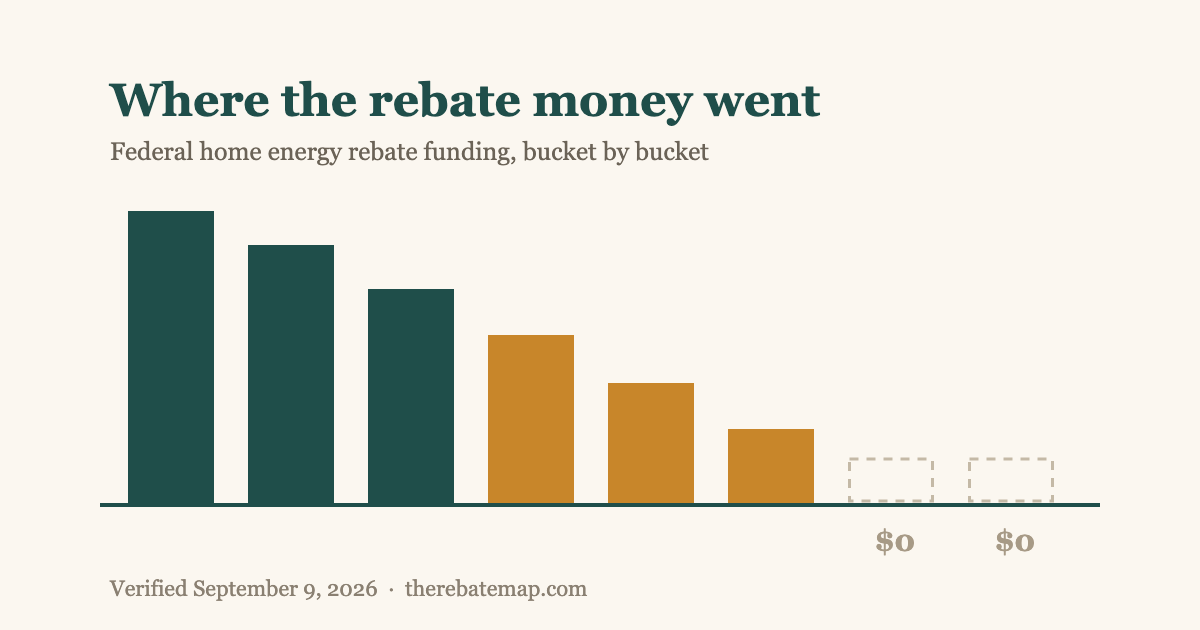
Three of the states that were handing out federal heat pump rebates in the spring of 2026 are not handing them out now. Colorado shows $0 remaining in both of its rebate regions. California stopped approving single-family reservations in February and has been running a waitlist ever since. Georgia shut its application window at 1:00 PM on a Friday afternoon in August because too many people applied.
None of those three states removed the rebate amounts from their websites. All three still publish the same $8,000 heat pump figure that brought you here. That is the part worth understanding: the number staying on the page does not mean the money is still there. These programs are funded from a fixed federal pot, not from an entitlement, and when a state’s pot empties the published rules keep describing you as eligible for something you can no longer receive.
This page tracks which pots are empty. We check each state’s own funding page and record what it says, in its own words, with the date the state stamped on it. Last verified September 9, 2026.
Where the door has already closed
| State | What closed | What the state publishes | Date on the page |
|---|---|---|---|
| Colorado | HEAR single-family, both regions | $0 remaining in Region 1 and Region 2; Program Closed for both | Dashboard stamped 08/3/26 |
| California | HEEHRA single-family reservations | Fully reserved statewide; unapproved requests placed on a waitlist | As of February 24, 2026 |
| Georgia | HEAR single-family and multifamily applications | No longer accepting new applications after 1:00 PM EST August 14, 2026 | August 14, 2026 |
Colorado is the only state that shows you the balance
Most states will tell you a program is open or closed. Colorado tells you how much money is left, which is rarer and more useful. The Colorado Energy Office publishes a HEAR dashboard with a remaining balance for each funding bucket, and on the version stamped Last Updated: 08/3/26 it reads $0 remaining for Region 1, the Front Range, and $0 remaining for Region 2, which is every other county. Both are labeled Program Closed.
The scale is worth stating plainly. Colorado said approximately $45.6 million was available in total, with about $31.9 million of that set aside for single-family households and $13.7 million dedicated to multifamily. The single-family share is the part that is gone. The multifamily pool still shows a remaining balance, and Colorado says rebates are not yet available for multifamily buildings, so that money is neither spent nor spendable right now.
There is a second sentence on Colorado’s program page that matters more than the dashboard if you are mid-project. Under an (Updated August 2026) stamp, the state writes that any household applications and project proposals submitted after August 1, 2026 for Region 2 will not be reviewed and will be denied. Not queued. Denied. If you submitted on August 3 and are waiting to hear back, that sentence is your answer.
We wrote about how quickly this happened in our page on the Colorado heat pump rebate, including the stretch where the state’s own program page still advertised a Region 2 deadline that the money had already overtaken.
California has been running a waitlist since February
California’s version of the program is called HEEHRA, and the California Energy Commission states that as of February 24, 2026, HEEHRA rebates for single-family home retrofits are fully reserved statewide. All reservation requests that have not been approved have been put on a waitlist in case budget becomes available again, and no new income verification requests are being accepted.
Read that carefully, because it is not the same as closed. California is still processing and finalizing rebate applications for completed projects that already hold an approved reservation. If you got your reservation before the door shut, you are still in the program. If you did not, you are on a list waiting for someone else’s project to fall through.
The published amounts have not changed: up to $8,000 for single-family households below 80 percent of area median income, up to $4,000 between 80 and 150 percent, and up to $14,000 per unit for income-qualified multifamily properties. Multifamily is the meaningful exception in California. It is still available statewide, and it is the more generous side of the program by a wide margin.
California received $290 million from the Department of Energy for HEEHRA, of which $152 million is earmarked for a Phase II that is not yet available. Its $291 million HOMES award has been approved since January 2025 and those rebates are still not available either. The state’s total federal award is $590 million. Roughly two-thirds of it has not reached a household yet. Our fuller writeup is at HEEHRA: California heat pump rebates fully reserved.
Georgia closed because it worked
Georgia is the instructive case, because it did not stall and it did not underspend. The Georgia Environmental Finance Authority stopped accepting new single-family and multifamily HEAR applications at 1:00 PM EST on August 14, 2026, and the reason it gives is a high volume of HEAR applications. Demand, not dysfunction.
The state had published its own scorecard four months earlier. In an April 9, 2026 press release marking the program’s first anniversary, GEFA reported more than $25 million in rebates, more than 1,900 households served, an average rebate of $10,160, average estimated annual energy savings of $1,465 per household, and more than 120 participating contractors. A program paying an average of ten thousand dollars a household will empty a fixed pot quickly, and it did.
Two details keep Georgia from being a simple success story. Four days before the general closure, on August 10, 2026, Georgia stopped accepting fuel-switching HEAR projects entirely, following updated federal guidance the state says had to be implemented by August 31, 2026. And Georgia’s HOMES program, the whole-house efficiency track, continues to accept applications. If you are a Georgia homeowner, HEAR is closed to you and HOMES is not.
Open, but the rules changed underneath you
There is a second failure mode that is easier to miss than an empty pot, and 2026 produced a lot of it. In late May the Department of Energy issued Program Notices 26-1 and 26-2, with an effective date of May 29, 2026, and the practical effect of 26-2 was to remove fuel switching from the HEAR program. That is a direct reversal of what most people believe these rebates are for. The original pitch was replacing a gas furnace or gas water heater with an electric heat pump. In state after state, that is now the one thing the rebate will not pay for.
- North Carolina. Energy Saver NC is open and paying, and it published the change itself: fuel switching projects are not allowed, electric-to-electric upgrades are allowed, and new insulation and air sealing standards apply. The binding sentence is that beginning September 1, 2026, all existing and new HEAR applications that have not yet reached rebate reservation status must comply with the new guidance. An application you filed in July under the old rules is not grandfathered unless it already has a reservation.
- Arizona. Efficiency Arizona still takes applications, under a banner reading that significant changes are coming to the program due to a federal government notice, and that applications must meet the new program guidelines. The published amounts are unchanged: up to $8,000 for a heat pump, $1,750 for a heat pump water heater, $840 each for an electric range and a heat pump dryer, $1,600 for insulation and air sealing, within a $14,000 household cap.
- Wisconsin. The Public Service Commission says Wisconsin’s programs remain operational while the guidance is under review. Focus on Energy, which runs the rebates, is more specific: as of September 1, 2026 it can no longer accept retail post-purchase or instant discount coupon requests for equipment replacing fossil fuel appliances. Coupons issued before that date remain valid until they expire.
- Michigan. MiHER is running statewide, but new income-qualified applications are temporarily unavailable in two EGLE districts, Detroit and Warren, while the program reviews current applications and funding capacity. Applications already submitted continue to be processed. This is not statewide exhaustion, and it is not nothing either.
The pattern across all four is the same. The program is open, the dollar figures are intact, and the eligibility rule that most people were relying on has quietly inverted. We tracked which states published the change and which stayed silent in the heat pump rebate rule that changed in May.
Five large states where the money never arrived at all
It is easy to assume that a state with a big federal award is a state with a live program. These five are not, and each of them says so in its own words.
| State | What the state says | Date on the page |
|---|---|---|
| Minnesota | Save Energy Minnesota has not launched yet; there is no estimated program launch date | Current update 6/12/2026 |
| Maryland | Conditionally approved; additional DOE approvals still required before funding is received and the programs can launch | Update 6/9/26 |
| Virginia | Asked whether the rebates are available now, the state answers No, and says it cannot provide an estimated date | Reflects the DOE notices of May 29, 2026 |
| Illinois | The program launch is pending USDOE approval; the HEAR application has not yet been processed | None shown |
| Texas | The HOMES and HEAR rebate programs are currently not available; still in the planning and design phase | Current Status updated May 19, 2026 |
Two smaller states go further than not-yet. Utah says its Home Energy Rebate program is on hold until further notice and that DOE has not approved Utah’s application. Vermont writes that its HEAR funding remains in question and recommends that residents not plan on HEAR funds for future projects. That is a state energy office telling you, in writing, not to count on the money.
Why a program can be open and still pay you nothing
Four different things get called open, and only one of them puts money in your pocket.
- Funded and reserving. The state has money, and it will commit a specific amount to your specific project before work starts. This is the only status that is worth anything.
- Funded but not reserving. Money exists at the state level, but the application or reservation channel is shut. Colorado Region 2 after August 1 and Georgia after August 14 are this.
- Awarded but not launched. DOE has awarded the state money, sometimes conditionally, and no household can apply. Minnesota, Maryland, Virginia, Illinois and Texas are all here, some of them for two years running.
- Open, but not for your project. The program takes applications and your particular upgrade is no longer eligible. Any gas-to-electric swap in a state that has implemented the May 2026 notices falls in this bucket.
The reservation is the thing that protects you
If you take one operational rule away from this page, make it this one: in every state we have read, the document that protects you is the reservation or preapproval, not the application, not the eligibility screen, and not the contractor’s reassurance.
California states it directly, that projects must have an approved reservation or they will not be funded with HEEHRA, and that rebates are not retroactive for equipment purchased or installed before a rebate is reserved and approved. Colorado states that you are not guaranteed a rebate until you and your registered contractor receive a formal reservation notice. North Carolina’s September 1 rule is written around the same pivot, applying the new restrictions to every application that has not yet reached rebate reservation status.
The practical consequence: do not sign a contract, pay a deposit, or let equipment be installed on the strength of an application you have merely submitted. In a program that can go from open to $0 in a matter of weeks, an unreserved application is a place in line, not a promise.
How to check your own state in five minutes
- Open your state energy office’s rebate page directly. Not a search result summary, not an aggregator, not a contractor’s landing page. Our state-by-state table links to the exact page we read for all fifty states and the District of Columbia.
- Find the date. If the page carries no update stamp and its newest concrete statement refers to 2024 or 2025, treat it as unverified rather than as good news. Several states are running two-year-old copy.
- Look for a balance or a dashboard, not just a status word. Colorado is the only state we found publishing a live remaining balance, but where one exists it is the most honest number on the site.
- Check whether your specific project is still eligible, separately from whether the program is open. If you are replacing a gas appliance, assume the answer is no until the page tells you otherwise in writing.
- Ask your contractor for the reservation number, not for reassurance. If they cannot produce one, you do not have a rebate yet.
One more thing worth repeating because a state energy office said it first. North Dakota, which has not launched, warns on its own page that any offers in North Dakota at this time related to these programs are likely scams or fraudulent. California publishes a similar warning about people claiming to represent the Energy Commission. Closed and unlaunched programs attract people who will happily collect your financial information on behalf of a rebate that does not exist.
What we checked, and when
Every figure and every status on this page was read on the state’s own official page, or on the Department of Energy’s, on September 9, 2026. Where a state publishes nothing, we say so rather than filling the gap from news coverage or third-party summaries. Where two official pages disagree, we say that too: the DOE program notices carry an effective date of May 29, 2026, but several state pages describe the same documents as issued on June 1, 2026, and we have not seen an official reconciliation of the two dates.
This page is a tracker, which means it is wrong the moment a state updates. If you are reading it well after the verification date above, open your state’s page yourself before you plan around anything here. Related reading: the state deadlines we could and could not verify, and which states actually publish the $8,000 figure.
Sources
- Colorado Energy Office, HEAR Dashboard and Colorado Home Energy Rebate Program
- California Energy Commission, Inflation Reduction Act Residential Energy Rebate Programs
- Georgia Environmental Finance Authority, HEAR Program Update and the April 9, 2026 GEFA press release
- North Carolina DEQ, HEAR Updates and Program Changes
- Efficiency Arizona, Public Service Commission of Wisconsin, Michigan EGLE
- Minnesota Commerce, Maryland Energy Administration, Virginia Energy, Illinois EPA, Texas SECO
- DOE Program Notice 26-1 and DOE Program Notice 26-2